



Orthodontist in Panvel: [Braces](/services/braces), Aligners, Bite Correction & How to Choose a Specialist
Crooked teeth.
A gap between the front teeth.
Teeth overlapping because there is not enough space.
A child whose upper and lower jaws do not seem to meet properly.
An adult who has wanted straighter teeth for years but does not want visible metal braces.
These are some of the most common reasons people begin searching for an orthodontist in Panvel.
But a useful orthodontic consultation should answer much more than:
“Do I need braces?”
It should answer:
What exactly is wrong with my bite?
Do I actually need treatment?
Should treatment happen now or later?
Are braces or clear aligners more suitable?
Who is qualified to supervise the movement of my teeth?
How long will treatment take?
What will keep the teeth straight after treatment finishes?
Orthodontics is the dental specialty concerned with diagnosing, preventing and correcting problems involving the alignment of teeth, the bite and development of the jaws.
The Dental Council of India’s postgraduate regulations describe Orthodontics and Dentofacial Orthopedics as the specialty concerned with prevention and correction of oral anomalies and malocclusion so that the structures involved can function normally. The MDS curriculum specifically includes diagnosis, treatment planning, clinical orthodontics, occlusion, dentofacial anomalies and preventive, interceptive and corrective orthodontic treatment.
The American Association of Orthodontists similarly defines an orthodontist as a dentist who has completed additional specialist education focused on diagnosing and treating irregularities of the teeth and jaws. Orthodontic treatment can involve braces, clear aligners, retainers and other appliances depending on the problem.
Quick Answer: What Does an Orthodontist Do?
An orthodontist specialises in diagnosing and correcting problems such as:
some impacted or unerupted teeth.
Treatment can include:
other specialist appliances when clinically appropriate.
Orthodontic care is not only about making teeth look straight.
The aim is also to create a stable, functional relationship between the upper and lower teeth and jaws.
What Is an Orthodontist?
An orthodontist is first trained as a dentist and then receives additional specialist education focused on:
dentofacial orthopedics.
In India, the recognised postgraduate specialty is:
MDS – Orthodontics and Dentofacial Orthopedics.
The Dental Council of India’s MDS curriculum includes study of:
clinical orthodontics.
That specialist education is the key distinction between an orthodontist and a dentist who simply provides some teeth-straightening treatments.
What Is Dentofacial Orthopedics?
Dentofacial orthopedics deals with the relationship between:
surrounding structures.
This becomes particularly relevant while children are still growing.
That is why orthodontics is broader than:
“making teeth straight.”
An orthodontist may sometimes need to evaluate how the jaws themselves are developing.
Dentist vs Orthodontist: What Is the Difference?
Every orthodontist is a dentist, but not every dentist is an orthodontist. Here is a clear overview of the differences:
| Aspect | General Dentist | Orthodontist |
|---|---|---|
| Primary Focus | Overall oral health, preventive care, cleanings, fillings, crowns & restorations | Tooth alignment, bite correction, facial harmony & jaw growth guidance |
| Qualification | BDS (Bachelor of Dental Surgery) | BDS + MDS (Master of Dental Surgery) in Orthodontics & Dentofacial Orthopedics |
| Specialist Education | Comprehensive dental training across all fields of dentistry | 3 additional years of dedicated postgraduate master's training exclusively in tooth movement & biomechanics |
| Appliances Provided | Routine dental treatments, basic aligner systems in select mild cases | Full spectrum: metal, ceramic, self-ligating, lingual braces, complex clear aligners, expanders & functional appliances |
| Complexity Handled | Mild alignment, routine restorations | Mild to severe crowding, skeletal discrepancies, open bites, crossbites, and multidisciplinary bite corrections |
✦General Dentist
A general dentist may provide:
general restorative treatment.
✦Orthodontist
An orthodontist focuses specifically on:
orthodontic growth and development.
The two roles complement each other.
A patient undergoing braces may still need their regular dentist for:
other general dental care.
Does Someone Who Provides Invisalign Automatically Become an Orthodontist?
No.
This distinction is extremely important.
A dentist may receive training or certification to provide a particular clear-aligner system.
That does not automatically mean the dentist has an MDS in Orthodontics and Dentofacial Orthopedics.
The AAO specifically addressed this misconception in 2026: not everyone who provides braces or clear aligners is an orthodontist. An orthodontist has completed additional specialist education specifically focused on how teeth and jaws move.
So when searching:
“orthodontist near me”
or:
“best orthodontist in Panvel,”
do not judge solely by whether a clinic advertises Invisalign.
Ask:
What is the treating clinician’s formal qualification?
Who is responsible for diagnosis and treatment planning?
Who monitors the movement of my teeth throughout treatment?
What Problems Does an Orthodontist Treat?
Orthodontic problems are collectively called malocclusions.
A malocclusion means that the teeth or jaws do not align in the ideal relationship.
✦1. Crooked Teeth
Teeth may erupt:
overlapping.
Orthodontic treatment gradually moves them toward improved alignment.
✦2. Crowded Teeth
Crowding occurs when there is insufficient space for the teeth to align properly.
You may notice:
difficulty cleaning between teeth.
✦3. Gaps Between Teeth
Spacing can occur because of:
other developmental factors.
A gap between the front teeth is called a diastema.
Not every small gap medically requires closure.
Treatment should be based on:
patient preference.
✦4. Overbite
An overbite refers to the vertical overlap between upper and lower front teeth.
Some overlap is normal.
An excessive or traumatic overbite may require orthodontic assessment.
✦5. Increased Overjet
Patients sometimes use “overbite” to describe upper front teeth that project significantly forward.
Technically, that horizontal distance is called overjet.
The distinction is useful because treatment planning can differ.
✦6. Underbite
An underbite occurs when the lower teeth or jaw sit forward relative to the upper teeth.
Some cases involve mainly tooth position.
Others involve the jaw relationship.
✦7. Crossbite
A crossbite occurs when one or more upper teeth bite inside the lower teeth instead of outside them.
It can affect:
both sides.
✦8. Open Bite
An open bite means some upper and lower teeth do not contact when the mouth closes.
For example, the front teeth may remain separated even when the back teeth touch.
✦9. Deep Bite
A deep bite occurs when the upper front teeth excessively overlap the lower front teeth vertically.
✦10. Impacted or Unerupted Teeth
Some permanent teeth fail to erupt normally.
Orthodontic treatment may sometimes be used alongside surgical or other dental treatment to guide selected teeth into position.
✦11. Jaw-Growth Problems
Children whose jaws are still developing may benefit from monitoring or treatment of certain skeletal relationships at the appropriate stage of growth.
Signs You May Need an Orthodontist
Consider an orthodontic assessment if you notice:
recurring cheek or lip trauma from tooth position.
Parents may also notice:
teeth erupting in unexpected positions.
An examination is needed to determine whether these findings require:
or no intervention.
When Should a Child First See an Orthodontist?
This is where one common myth needs correcting.
A child does not necessarily need braces at age seven.
But the American Association of Orthodontists recommends a child’s first orthodontic evaluation no later than age seven, or earlier if an orthodontic problem is recognised.
Why?
Around this age, children often have a mixture of:
permanent teeth.
The orthodontist can assess:
emerging orthodontic problems.
Does an Age-7 Check-Up Mean Braces at Age 7?
No.
This is extremely important for parents.
Most seven-year-olds do not need full braces.
The purpose of early evaluation is to determine whether the child should:
or wait until more permanent teeth erupt.
The AAO explicitly notes that early orthodontic treatment is not about rushing every child into braces. Some developing problems may benefit from early intervention, while many children simply need observation.
Can Children Start Braces Before Age 12?
Yes, in selected situations.
There is no universal rule that orthodontic treatment can only begin after age 12.
The ideal timing depends on:
eruption of permanent teeth.
Many comprehensive braces cases begin during adolescence, but certain problems can be treated earlier.
This is why evaluation age and treatment age are not the same thing.
Orthodontic Treatment for Teenagers
Teenage years are a common time for orthodontic treatment because many permanent teeth have erupted while facial development may still be occurring.
Common problems include:
bite problems.
Treatment options may include:
selected clear aligner systems.
Orthodontic Treatment for Adults
There is no universal upper age limit for straightening teeth.
Adults can undergo orthodontic treatment when their:
gums
are sufficiently healthy.
The AAO notes that tooth movement remains biologically possible in adulthood, while Cleveland Clinic also confirms that orthodontic treatment is used in adults as well as younger patients.
Adults commonly seek treatment because of:
aesthetic concerns.
Does Adult Orthodontic Treatment Take Longer?
Sometimes, but not automatically.
Treatment duration depends much more on:
patient compliance.
Age alone does not determine treatment length.
Can Adults With Gum Disease Have Braces or Aligners?
Active periodontal disease should generally be stabilised before orthodontic tooth movement begins.
The AAO also stresses that adult orthodontic treatment requires proper in-person evaluation of gum health and underlying structures. Moving teeth where periodontal support is poor can increase the risk of recession, root problems or tooth loss.
So orthodontic treatment should begin with:
healthy enough teeth and gums first.
What Treatments Does an Orthodontist Provide?
✦Metal Braces
Traditional fixed braces use:
other components
to gradually move teeth.
Metal braces remain one of the most versatile orthodontic treatment methods.
The current Dental Essential braces offers traditional metal braces for alignment and bite correction.
✦Ceramic Braces
Ceramic braces work similarly to conventional fixed braces but use tooth-coloured or less-visible brackets.
They may appeal to teenagers and adults who want a more discreet fixed-appliance option.
Dental Essential currently offers ceramic braces alongside traditional metal braces.
✦Self-Ligating Braces
Some fixed braces use specialised clips rather than elastic ties to hold the archwire.
The AAO lists self-ligating systems among available orthodontic bracket designs.
Whether they provide a meaningful advantage for a particular patient depends on the case and treatment goals.
✦Lingual Braces
Lingual braces are attached to the inner surface of the teeth.
This makes them less visible from the front.
The AAO recognises lingual braces as one aesthetic fixed-appliance option.
They are not necessarily appropriate or available for every patient or clinic.
✦Clear Aligners
Clear aligners use a series of custom-made removable trays to gradually move teeth.
They may be used to treat selected:
open-bite problems.
The AAO notes that aligners can treat a range of orthodontic problems but are not appropriate for everyone; some tooth movements are treated more predictably using braces or combination approaches.
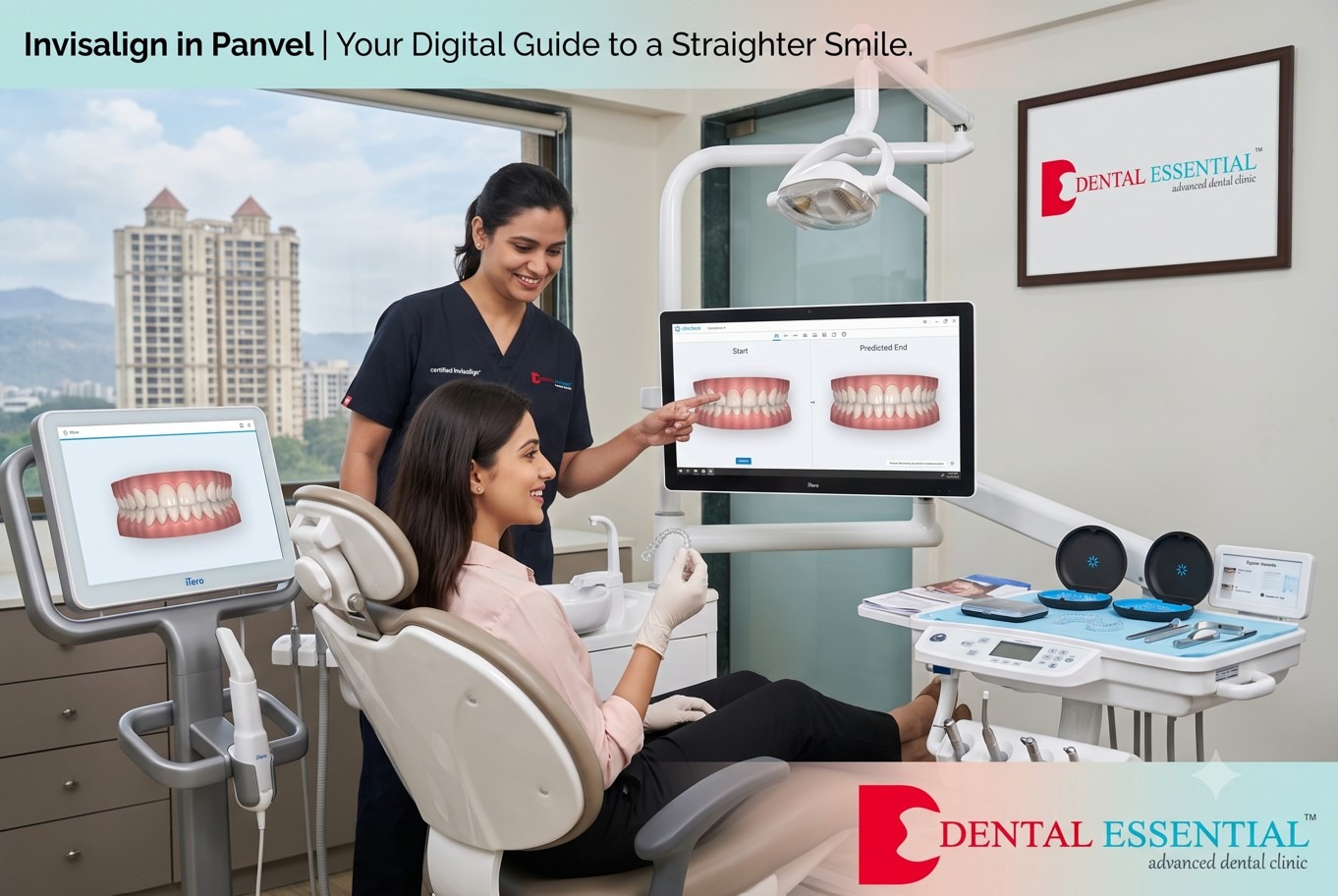
Dental Essential currently provides Clear Aligners or Invisalign in Panvel.
✦Palatal Expanders
Some growing children with a narrow upper jaw may benefit from an expansion appliance.
AAO describe palate expansion as an orthodontic option in appropriately selected children.
✦Functional Appliances
Certain growing patients may use removable or fixed functional appliances to influence the relationship between the upper and lower jaws.
The exact appliance depends on the diagnosis.
✦Temporary Anchorage Devices
Temporary anchorage devices, or TADs, are small temporary anchorage points that orthodontists can sometimes use to help produce specific tooth movements.
The AAO includes TADs among contemporary orthodontic tools.
They are not needed for most patients.
✦Retainers
Retainers are used after active orthodontic treatment to help keep teeth in their corrected positions.
This stage is not optional housekeeping.
It is part of orthodontic treatment.
Braces vs Clear Aligners: Which Is Better?
Neither treatment is universally better.
The right choice depends on:
aesthetic preference.
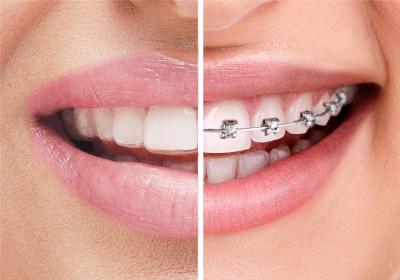
| Factor | Braces (Fixed) | Clear Aligners (Removable) |
|---|---|---|
| Visibility | More noticeable (metal or tooth-coloured ceramic brackets) | Discreet and virtually invisible |
| Removability | Fixed to teeth throughout treatment | Fully removable for eating, brushing, and special occasions |
| Patient Compliance | Fixed in place — works 24/7 without patient remembering | Highly dependent on patient discipline (wear 20–22 hours/day) |
| Diet & Eating | Certain dietary precautions needed (avoid sticky, very hard foods) | No dietary restrictions (aligners are removed during meals) |
| Oral Hygiene & Cleaning | Requires meticulous technique (interdental brushes, floss threaders) | Simple — brush and floss normally after removing aligners |
| Complex Movements | Exceptional control for severe rotations, deep bites, and skeletal corrections | Highly effective for mild to moderate and selected complex cases |
| Risk of Misplacement | Low (securely bonded to teeth) | Possible (aligners can be misplaced if not kept in case) |
| Treatment Planning | Requires comprehensive orthodontic diagnosis | Requires comprehensive orthodontic diagnosis |
The AAO emphasises that there is not one universally correct appliance for every patient. Diagnosis should come first, then the appliance should be selected according to the movements required.
Are Clear Aligners Only for Mild Cases?
No—but they are not appropriate for every complex case either.
Modern clear-aligner treatment can manage a wider range of orthodontic problems than early systems could.
However, some tooth movements or severe malocclusions remain:
or require combined techniques.
The AAO specifically states that aligners can treat several forms of malocclusion but that some cases are more predictably treated with braces.
Avoid oversimplified claims such as:
“aligners are only for easy cases”
or:
“aligners can fix everything.”
Both are inaccurate.
Invisalign vs Clear Aligners: Are They the Same?
Invisalign is a brand of clear-aligner treatment.
“Clear aligners” is the broader treatment category.
Other aligner systems also exist.
The important factor is not only the brand.
Outcome depends on:
professional monitoring.
Is Invisalign Better Than Braces?
Not automatically.
For one patient, aligners may provide:
easier cleaning.
For another patient, braces may give more predictable control of complex movements.
Treatment method should follow diagnosis.
What Happens During an Orthodontic Consultation?
A proper orthodontic consultation should involve much more than looking at the front teeth.
✦Medical and Dental History
Your clinician may ask about:
previous extractions.
✦Clinical Examination
The dentist or orthodontist evaluates:
tooth eruption.
✦Photographs
Clinical photographs may document:
facial appearance.
✦Digital Scan or Dental Impressions
Three-dimensional scans or impressions can record tooth positions.
Dental Essential’s braces service states that its assessment includes examination, X-rays and digital scans.
✦Dental X-Rays
Depending on the case, orthodontic imaging may help assess:
dental abnormalities.
The AAO stresses that photographs and digital scans cannot reveal everything underneath the gums, which is why proper in-person clinical and radiographic evaluation remains important for safe treatment.
✦Cephalometric Analysis
Selected orthodontic cases may use a lateral cephalometric X-ray to analyse relationships between:
skull.
This information can be useful in more complex bite and growth cases.
✦Gum and Oral-Hygiene Assessment
Before teeth are moved, the supporting tissues need to be healthy enough.
This is especially important in adults.
✦Treatment Planning
Only after diagnosis should the clinician discuss:
retention.
Do You Need Teeth Extracted Before Braces?
Not everyone needs tooth extraction.
Some patients have sufficient space.
Others may need space created through:
another treatment strategy.
The decision depends on:
periodontal health.
A patient should understand why extraction is being recommended before agreeing.
Can Wisdom Teeth Make Front Teeth Crooked?
Wisdom teeth and lower-front-tooth crowding have a complicated relationship.
Patients should not automatically assume:
“my wisdom teeth pushed all my front teeth forward.”
Late tooth movement can occur for multiple biological reasons.
Wisdom-tooth extraction should therefore not be recommended solely as a guaranteed method of preventing future orthodontic crowding.
How Long Does Orthodontic Treatment Take?
There is no universal treatment duration.
Dental Essential’s braces took approximately 12–24 months as a typical braces-treatment estimate, depending on severity.
Treatment time depends on:
biological response.
Never choose an orthodontist simply because an advertisement promises:
“perfect teeth in six months.”
The safest treatment time is the one appropriate for your actual case.
How Often Are Orthodontic Appointments Needed?
Appointment frequency depends on:
clinician’s protocol.
The current NHS braces guidance says fixed-brace patients commonly attend adjustment appointments approximately every six to eight weeks, while individual schedules vary.
At Dental Essential monthly adjustments on its braces and periodic progress checks for aligners.
Your treating clinician should give you the appropriate schedule for your appliance.
Do Braces Hurt?
Braces should not cause constant severe pain.
However, patients commonly experience temporary:
soreness
after:
some adjustments.
The NHS notes that teeth may feel sore for a few days after braces are fitted.
Severe or persistent pain should be discussed with your orthodontic provider.
Are Clear Aligners Painful?
Clear aligners also move teeth using controlled pressure.
Temporary tightness or tenderness can occur when:
additional tooth movement occurs.
They should not be marketed as completely sensation-free.
Why Oral Hygiene Matters During Braces
Brackets and wires create additional surfaces where food and plaque can collect.
If plaque repeatedly remains around braces, patients can develop:
bleeding gums.
The NHS stresses that fixed-brace patients need particularly careful brushing and interdental cleaning and should continue routine general dental check-ups.
Orthodontic treatment moves teeth.
It does not replace general dental care.
Should Cavities Be Treated Before Braces?
Generally, active dental disease should be controlled before orthodontic appliances are placed.
This may include:
periodontal disease.
What Are the Risks of Orthodontic Treatment?
Orthodontics is highly established, but it is not risk-free.
Potential concerns can include:
temporary discomfort.
NHS specialist guidance identifies poor oral hygiene, enamel damage, periodontal effects, root shortening and post-treatment relapse among recognised orthodontic risks.
This does not mean orthodontic treatment is unsafe.
It means:
diagnosis + hygiene + monitoring + retention matter.
What Happens After Braces or Aligners Are Finished?
Treatment is not finished when the teeth look straight.
The next stage is retention.
Teeth have a biological tendency to move after orthodontic appliances are removed.
Retainers may be:
fixed bonded retainers.
The AAO states that long-term retainer wear is usually necessary to reduce unwanted tooth movement after orthodontic treatment.
Do You Need Retainers Forever?
Many contemporary orthodontic recommendations support very long-term or indefinite retention if patients want to minimise relapse.
The exact wear schedule changes over time and depends on the case.
Your orthodontist should tell you:
how often it should be checked.
Do not spend months or years straightening teeth and then assume retainers no longer matter.
What Happens if You Stop Wearing Your Retainer?
The teeth may gradually move.
This is called orthodontic relapse.
Movement can be:
or large enough that retreatment is considered.
The AAO warns that patients who do not wear their retainers as prescribed have a greater chance of teeth shifting back toward their previous positions.
Braces Cost in Panvel
Orthodontic cost depends on:
whether retainers are included.
Dental Essential’s current braces service page lists treatment starting from approximately:
Metal braces: ₹20,000
Ceramic braces: ₹30,000
depending on case complexity.
These should be treated as current starting figures, not a universal final price.
Ask what is included.
Clear Aligners Cost in Panvel
Dental Essential’s clear-aligner page lists approximately:
₹80,000 to ₹3,00,000
depending on:
case complexity.
A large price range is expected because one patient might need relatively simple movement while another requires:
a longer treatment plan.
Before Comparing Orthodontic Prices, Ask What Is Included
Ask whether the quotation includes:
emergency repairs.
A low headline price may not be directly comparable to a package that includes more stages of care.
Cheapest Braces vs Best Orthodontic Value
Cost matters.
Especially when treatment may continue for:
or longer.
But choose based on more than:
“who has the cheapest braces in Panvel?”
Consider:
total cost.
The most expensive treatment is not automatically best.
The cheapest treatment is not automatically bad.
What matters is whether the treatment is appropriate, supervised and transparent.
How to Choose an Orthodontist in Panvel
✦1. Verify the Qualification
If you are specifically seeking an orthodontist, ask whether the treating clinician has a recognised qualification such as:
MDS – Orthodontics and Dentofacial Orthopedics.
The DCI formally recognises Orthodontics and Dentofacial Orthopedics as a postgraduate specialty with dedicated diagnostic, clinical and treatment-planning training.
✦2. Ask Who Will Actually Treat You
A multispecialty clinic may have:
aligner providers.
Ask:
Who makes my orthodontic diagnosis?
Who creates my treatment plan?
Who supervises adjustments?
✦3. Do Not Confuse Aligner Certification With Orthodontic Specialty Training
A clear-aligner certification can be useful training.
But it is not equivalent to completing specialist MDS Orthodontics training.
✦4. Expect Proper Diagnostic Records
Be cautious if extensive tooth movement is recommended after nothing more than:
digital scan
without an appropriate oral-health assessment.
The AAO stresses the importance of in-person examination and diagnostic information for evaluating roots, gums and tooth position.
✦5. Ask for the Diagnosis
You should be able to understand:
another problem.
Treatment should have a diagnosis—not just a product name.
✦6. Ask Why Braces or Aligners Are Recommended
The answer should relate to:
aesthetics.
Not simply:
“aligners are newer.”
✦7. Ask About Alternatives
A responsible treatment discussion may include:
delayed treatment.
✦8. Ask Whether Extractions Are Necessary
If extractions are recommended, ask:
what alternative strategies were considered.
✦9. Ask About Retainers Before Starting
Do not wait until the final appointment to learn that retention is necessary.
Ask:
long-term wear schedule.
✦10. Evaluate Follow-Up Convenience
Orthodontics involves repeated visits.
Location therefore matters more than it would for a one-time treatment.
A qualified provider reasonably close to:
workplace
can make a long treatment journey easier.
Red Flags When Choosing Orthodontic Treatment
✦“Guaranteed Perfect Smile in X Months”
Treatment time is biologically variable.
✦“No X-Ray Ever Needed”
Imaging requirements differ between patients, but proper diagnostic assessment matters.
✦“Everyone Should Choose Aligners”
No single appliance is appropriate for every malocclusion.
✦“Everyone Needs Braces”
Some patients need:
another approach.
✦“Retainers Are Optional”
Relapse is a recognised long-term concern.
✦“Anyone Offering Aligners Is an Orthodontist”
False.
✦“Braces Are Only for Children”
False.
Adults can undergo orthodontic treatment when oral health allows.
✦“Your Child Must Wait Until 12”
Not necessarily.
The AAO recommends orthodontic evaluation by seven, with treatment timing determined individually.
Orthodontist Near Me: Why Local Follow-Up Matters
Orthodontic treatment is not:
consultation → braces → done.
It often involves:
retention follow-up.
For people living and working around Panvel and Navi Mumbai, this makes accessibility relevant.
A clinic that requires an exhausting trip for every adjustment can make a long treatment plan harder to maintain.
That does not mean choosing the closest clinic regardless of qualifications.
A better formula is:
appropriate expertise + realistic accessibility + consistent follow-up.
Orthodontic Treatment and Panvel’s Working Lifestyle
Many people in Panvel balance:
daily commuting.
That affects which orthodontic option feels practical.
A working adult may prefer clear aligners because they are less visible during:
customer interactions.
A teenager may prefer ceramic braces for appearance or metal braces because they are fixed and do not depend on remembering to wear removable trays.
Neither preference makes one option medically superior.
Lifestyle should influence the treatment decision after the orthodontic diagnosis is understood.
Braces and School or College Life
Parents often worry that braces will interfere with:
speaking.
Most students adapt.
But treatment requires:
management of occasional broken brackets or wires.
Planning appointments around major exam periods can make treatment easier.
Orthodontics Before Weddings and Major Events
In Panvel and Navi Mumbai, adults sometimes begin searching for:
clear aligners for wedding
or:
invisible braces before marriage.
This is understandable.
But orthodontic tooth movement requires time.
If your wedding is three months away and the orthodontic problem normally requires considerably longer treatment, biology does not change because of the event date.
Consult early.
For short-term aesthetic concerns, ask what can realistically be achieved and whether another cosmetic approach is appropriate—but do not allow a rushed cosmetic deadline to create an unsafe orthodontic plan.
Festivals and Orthodontic Care
Celebrations such as:
family functions
often involve foods that can be:
crunchy.
Patients with fixed braces should follow their orthodontist’s dietary instructions because hard or sticky foods can damage brackets and wires.
Current NHS guidance similarly advises avoiding foods likely to break fixed braces.
You do not need to avoid celebrations.
You simply need to protect the appliance.
Affordability and Orthodontic Treatment in Panvel
Orthodontic treatment is a significant expense for many families.
People have different:
healthcare priorities.
Those differences should influence how options are explained, not assumptions about who cares more about oral health.
For example, a family may reasonably compare:
clear aligners.
A responsible consultation should explain:
What is clinically suitable?
Which options are mainly aesthetic upgrades?
What is included in the price?
Can treatment be paid in stages if the clinic allows it?
A lower-cost treatment option is not automatically inferior when it can correctly treat the malocclusion.
Religion, Caste, Community or Politics Do Not Determine Who Needs Braces
Orthodontic treatment should be based on:
patient goals.
It should not be based on assumptions about:
political beliefs.
Interestingly, the DCI’s own MDS Orthodontics training objectives explicitly emphasise ethical care irrespective of social status, caste, creed or religion, while also training specialists to understand relevant social, cultural, economic, genetic and environmental factors when managing dentofacial problems.
That is the appropriate way to localise healthcare:
understand a patient’s real circumstances without turning identity into a biological stereotype.
What Government Regulation Is Relevant When Choosing an Orthodontist?
For a patient, the useful regulatory question is not political.
It is professional:
What dental qualification does this person actually hold?
India’s Dental Council regulations recognise Orthodontics and Dentofacial Orthopedics as a formal MDS specialty and define the training requirements for postgraduate orthodontic education.
When comparing providers, qualifications should therefore be transparent.
Orthodontic Care at Dental Essential, Panvel
Dental Essential currently offers treatment for:
bite problems
through its Dental Braces and Clear Aligners/Invisalign services.
Current treatment options published by the clinic include:
retention after treatment.
The clinic’s braces workflow currently includes:
retention.
Its clear-aligner workflow includes:
retention.
Dental Essential’s Current Braces Cost
Dental Essential currently lists braces treatment starting from approximately:
Metal braces – ₹20,000
Ceramic braces – ₹30,000
with final cost depending on case complexity.
Patients should confirm:
other potential charges
before beginning treatment.
Dental Essential’s Current Clear Aligner Cost
Dental Essential currently lists clear-aligner treatment between approximately:
₹80,000 and ₹3,00,000
depending on brand and case complexity.
The final cost should be based on an individual assessment.
About Dental Essential’s Clinical Team
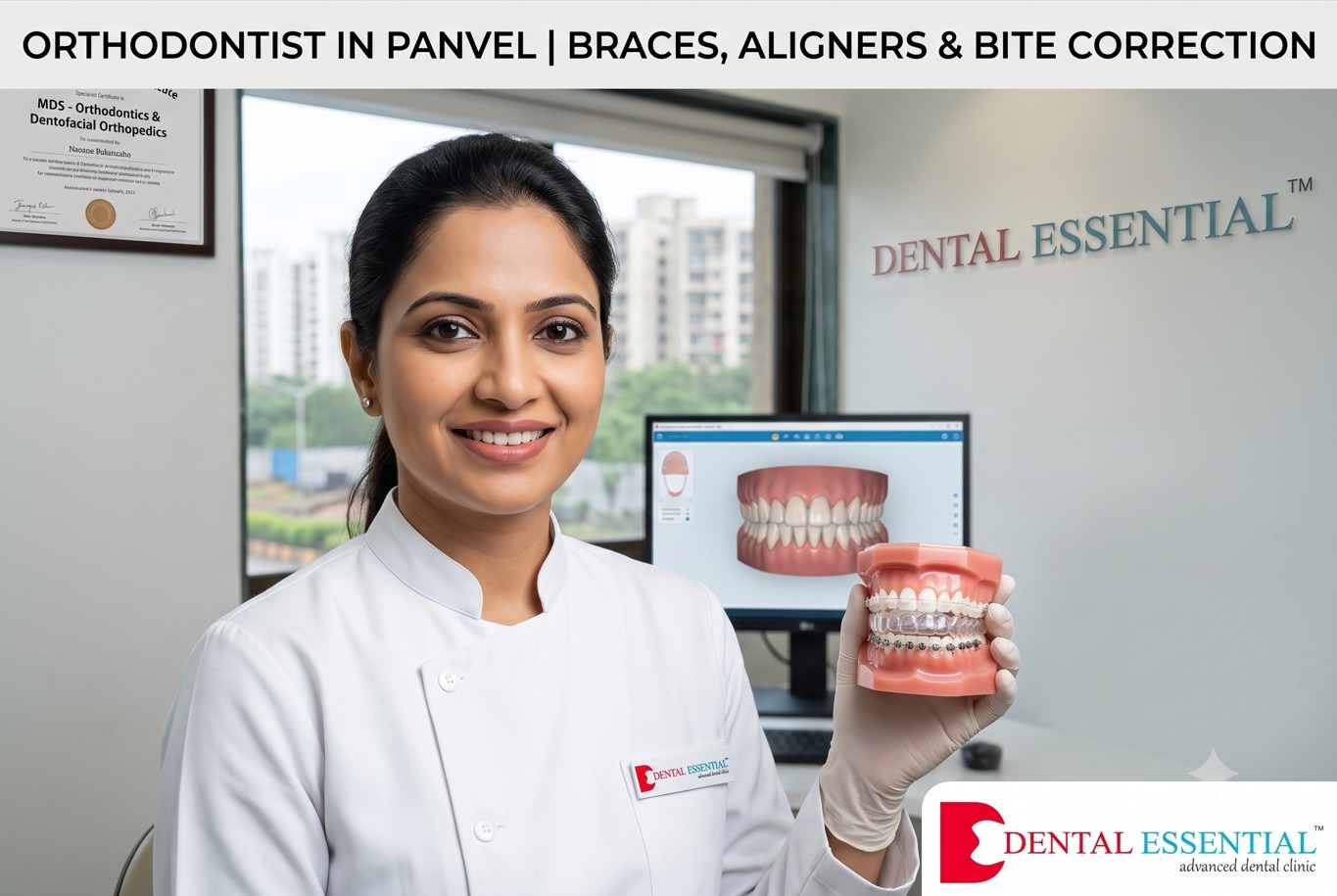
Dental Essential is led by Dr. Sameer Ramchandra Gharat (BDS, MDS – Prosthodontics & Implantology), Prosthodontist & Implantologist with 16+ years of clinical experience, and a certified Invisalign provider. The orthodontic department also features dedicated specialist consultant orthodontists (Dr. Ansil Pappachan – MDS Orthodontics, Consultant Braces & Clear Aligners Specialist).
For provider-specific orthodontic treatment, patients should feel completely comfortable asking which clinician will:
Transparent credentials ensure high standards of care and clinical safety.
Dental Essential – Advanced Dental Clinic in Panvel
These are Dental Essential’s current published contact details and hours.
Areas Served
Dental Essential’s current homepage lists patients from:
Navi Mumbai.
Final Takeaway
An orthodontist does much more than put brackets on teeth.
Orthodontics involves:
and long-term retention.
You may benefit from an orthodontic assessment if you have:
teeth that are difficult to clean because of their position.
Parents should also remember an important distinction:
age seven is a recommended age for the first orthodontic evaluation—not an automatic age for braces.
Adults should know another:
you are not “too old” for orthodontics simply because you missed braces as a teenager.
And anyone considering clear aligners should remember:
the appliance brand is not the diagnosis.
Whether you use:
another orthodontic appliance
should depend on the movement your teeth actually require.
When searching for an orthodontist in Panvel, verify:
retainer plan.
For braces treatment, clear aligners, Invisalign and teeth-alignment assessment in Panvel:
Contact: Dental Essential – Advanced Dental Clinic
📍 Address: Shop 16, Bldg 7/B, Gurusharnam Complex, Vishrali Naka, Panvel – 410206
📞 Phone: +91 877-9646573
⏰ Clinic Hours: Monday – Saturday: 10:00 AM – 2:00 PM & 5:00 PM – 9:00 PM | Sunday: Closed
Frequently Asked Questions About Orthodontists
✦What is an orthodontist?
An orthodontist is a dentist with additional specialist education focused on diagnosing and treating misalignment of the teeth and jaws.
✦What is orthodontics?
Orthodontics is the dental specialty concerned with correcting malocclusion, tooth alignment and bite problems.
✦What is dentofacial orthopedics?
Dentofacial orthopedics focuses on development and guidance of the jaws and facial structures, especially during growth.
✦What qualification should an orthodontist have in India?
The recognised postgraduate specialty is MDS – Orthodontics and Dentofacial Orthopedics.
✦Is every dentist an orthodontist?
No.
Orthodontists first train as dentists and then complete additional specialist orthodontic education.
✦Can a general dentist provide braces?
Some dentists receive additional orthodontic or aligner training and provide selected treatment.
But providing braces or aligners does not automatically make someone an orthodontist.
✦Is an Invisalign provider an orthodontist?
Not necessarily.
A clinician can receive Invisalign or clear-aligner training without holding an MDS Orthodontics qualification.
✦Should I see an orthodontist or dentist first?
A general dentist can identify obvious alignment concerns and refer where appropriate.
Patients can also directly seek an orthodontic assessment when concerned about tooth or jaw alignment.
✦What problems does an orthodontist treat?
Common conditions include:
selected jaw-development problems.
✦What is malocclusion?
Malocclusion means an abnormal relationship between the teeth or jaws when biting.
✦How do I know if I need braces?
Possible signs include:
abnormal bite.
An examination determines whether treatment is actually required.
✦Do crooked teeth always need treatment?
No.
Minor irregularities may not require treatment if:
stability
are acceptable and the patient is happy with appearance.
✦Are braces only cosmetic?
No.
Orthodontic treatment can also address:
some oral-hygiene difficulties caused by tooth position.
✦What age should a child see an orthodontist?
The AAO recommends a first orthodontic check-up no later than age seven.
✦Does a seven-year-old need braces?
Usually not automatically.
The age-seven recommendation is primarily for evaluation and monitoring. Some children need early treatment; many do not.
✦What age is best for braces?
There is no universal best age.
Many comprehensive cases begin in adolescence, but treatment timing depends on:
type of malocclusion.
✦Can braces start before age 12?
Yes, selected orthodontic problems may be treated earlier.
✦Can adults get braces?
Yes.
Adults can undergo orthodontic treatment when the teeth and supporting tissues are sufficiently healthy.
✦Is 30 too old for braces?
No.
✦Is 40 too old for braces?
Not automatically.
Periodontal health becomes especially important in adult orthodontic treatment.
✦Is 50 too old for braces or aligners?
Age alone does not automatically prevent orthodontic treatment.
The clinician must evaluate:
general dental condition.
✦Should gum disease be treated before braces?
Yes, active periodontal disease should generally be stabilised before orthodontic tooth movement.
✦Should cavities be treated before braces?
Active decay should be addressed before beginning orthodontic treatment.
✦Which is better, braces or clear aligners?
Neither is universally better.
The correct choice depends on diagnosis, tooth movements, complexity and patient preferences.
✦Are aligners as effective as braces?
Clear aligners can effectively treat many orthodontic problems.
Some complex movements may still be more predictably treated using braces or combined approaches.
✦Are clear aligners invisible?
They are transparent and much less visible than conventional braces, but they are not literally invisible.
Attachments may also be placed on some teeth.
✦How many hours per day should clear aligners be worn?
Wear instructions depend on the treatment system and orthodontic plan.
Many aligner systems require approximately 20–22 hours per day. Dental Essential currently advises 20–22 hours on its aligner page.
✦What happens if I do not wear my aligners enough?
Treatment can fall behind the planned tooth movements and trays may stop fitting correctly.
✦Are metal braces better for complex cases?
Fixed braces can treat a very broad range of malocclusions.
Some complex movements may be more predictable with braces, though suitability remains individual.
✦Are ceramic braces effective?
Ceramic fixed braces operate using similar basic principles to metal fixed braces but provide a less-visible bracket option.
✦Do braces hurt?
Temporary soreness or pressure is common after fitting and some adjustments.
✦How long does braces treatment take?
Treatment length varies.
Dental Essential currently gives approximately 12–24 months as a typical estimate, while complex cases can take longer.
✦How long do clear aligners take?
Treatment duration depends on the amount and type of movement required.
It should be estimated after diagnosis rather than from a general online promise.
✦How often will I need orthodontic appointments?
Fixed-brace appointments are commonly scheduled every several weeks; the exact interval depends on the treatment stage and clinician.
✦Do I need X-rays before braces?
Orthodontic imaging is chosen according to clinical need.
Appropriate radiographs can help assess:
jaw relationships.
✦Can an orthodontist tell everything from a digital scan?
No.
Digital scans show the visible teeth well but cannot reveal all structures underneath the gums.
In-person examination and appropriate imaging remain important.
✦Do braces cause cavities?
Braces do not directly create cavities.
However, brackets and wires can make plaque removal more difficult, so poor oral hygiene can increase cavity risk.
✦Can braces damage gums?
Poor oral hygiene and inappropriate tooth movement can contribute to gum problems.
Periodontal health should be monitored throughout treatment.
✦Can braces shorten tooth roots?
Some root shortening can occur during orthodontic treatment.
Usually it is limited, but it is a recognised potential risk.
✦Do teeth move back after braces?
They can.
This is called relapse.
✦Do I need a retainer after orthodontic treatment?
Yes.
Retention is an important part of maintaining orthodontic results.
✦How long do retainers need to be worn?
Many orthodontists recommend long-term retainer use.
Your individual schedule should come from the treating clinician.
✦Can braces fix jaw problems?
Some bite problems can be managed orthodontically or with growth-modifying treatment in younger patients.
Severe skeletal discrepancies in adults may require multidisciplinary treatment, including jaw surgery in selected cases.
✦Can braces fix an overbite?
Many overbite problems can be treated orthodontically.
The treatment depends on whether the problem mainly involves:
both.
✦Can braces fix an underbite?
Many underbites can be improved orthodontically, particularly when the discrepancy is dental.
More severe skeletal problems may need multidisciplinary treatment.
✦Can braces close gaps between teeth?
Yes, orthodontic tooth movement can close many types of spacing.
The underlying cause should also be evaluated.
✦Can orthodontics fix crowded teeth without extraction?
Sometimes.
Whether extraction is needed depends on:
available space.
✦Do wisdom teeth have to be removed before braces?
Not automatically.
Wisdom-tooth treatment should be based on its own clinical indications.
✦Can I play sports with braces?
Usually yes.
An appropriate orthodontic mouthguard may be recommended for contact sports.
✦What should I avoid eating with braces?
Very hard, sticky or crunchy foods can damage fixed appliances.
✦Can adults choose clear aligners for work?
Yes, when clinically suitable.
Their less-visible appearance makes them attractive to many professionals.
✦What is the cost of braces in Panvel?
Dental Essential currently lists:
depending on case complexity.
✦What is the cost of clear aligners in Panvel?
Dental Essential currently lists approximately ₹80,000–₹3,00,000, depending on the aligner brand and case complexity.
✦How do I choose the best orthodontist in Panvel?
Look for:
clear costs.
✦Where can I get braces or clear aligners in Panvel?
Dental Essential provides braces and clear-aligner consultations at:
📍 Address: Shop 16, Bldg 7/B, Gurusharnam Complex, Vishrali Naka, Panvel – 410206
📞 Phone: +91 877-9646573
Ready for a Healthier, Straighter Smile?
Consult with expert dentists at Dental Essential Clinic in Panvel. Get personalized treatment plans & affordable care.
Share this article