



Implant Dentists in Panvel: How to Choose the Right Dental Implant Specialist
Choosing an implant dentist is a major decision.
Dental implant treatment is not simply about inserting a screw into the jaw and attaching an artificial tooth. It requires accurate diagnosis, surgical planning, careful implant placement, natural-looking tooth design, proper bite management and long-term maintenance.
The skill and treatment-planning approach of your implant dentist in Panvel can influence how comfortably the implant functions, how naturally the replacement tooth looks and how easily you can maintain it in the future.
If you are searching online for:
this guide will help you understand what an implant dentist does, which qualifications matter, what questions to ask and how to compare treatment recommendations responsibly.
Quick Answer: What Is an Implant Dentist?
An implant dentist is a qualified dental professional with additional education, training and clinical experience in planning, placing, restoring or maintaining dental implants.
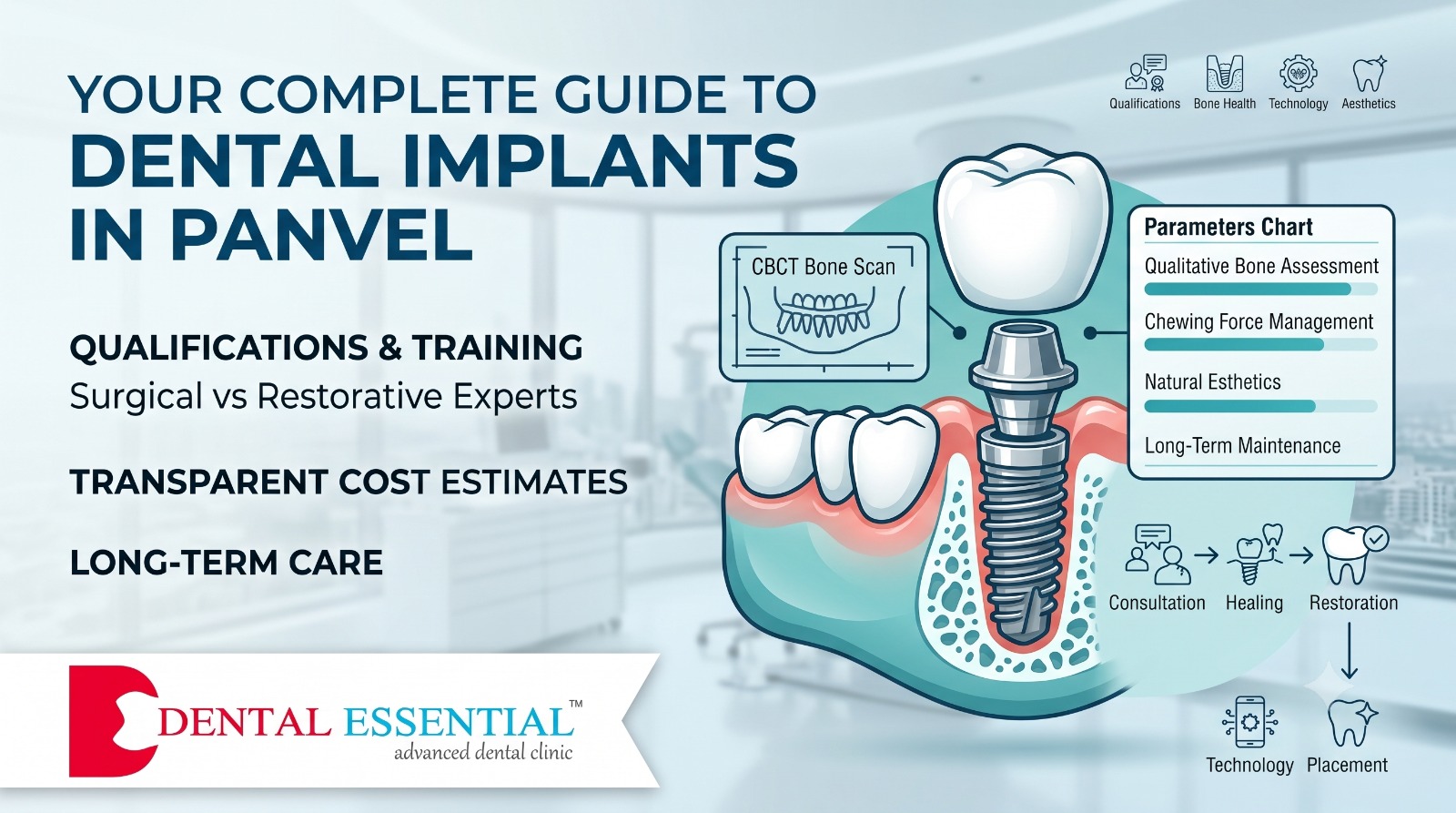
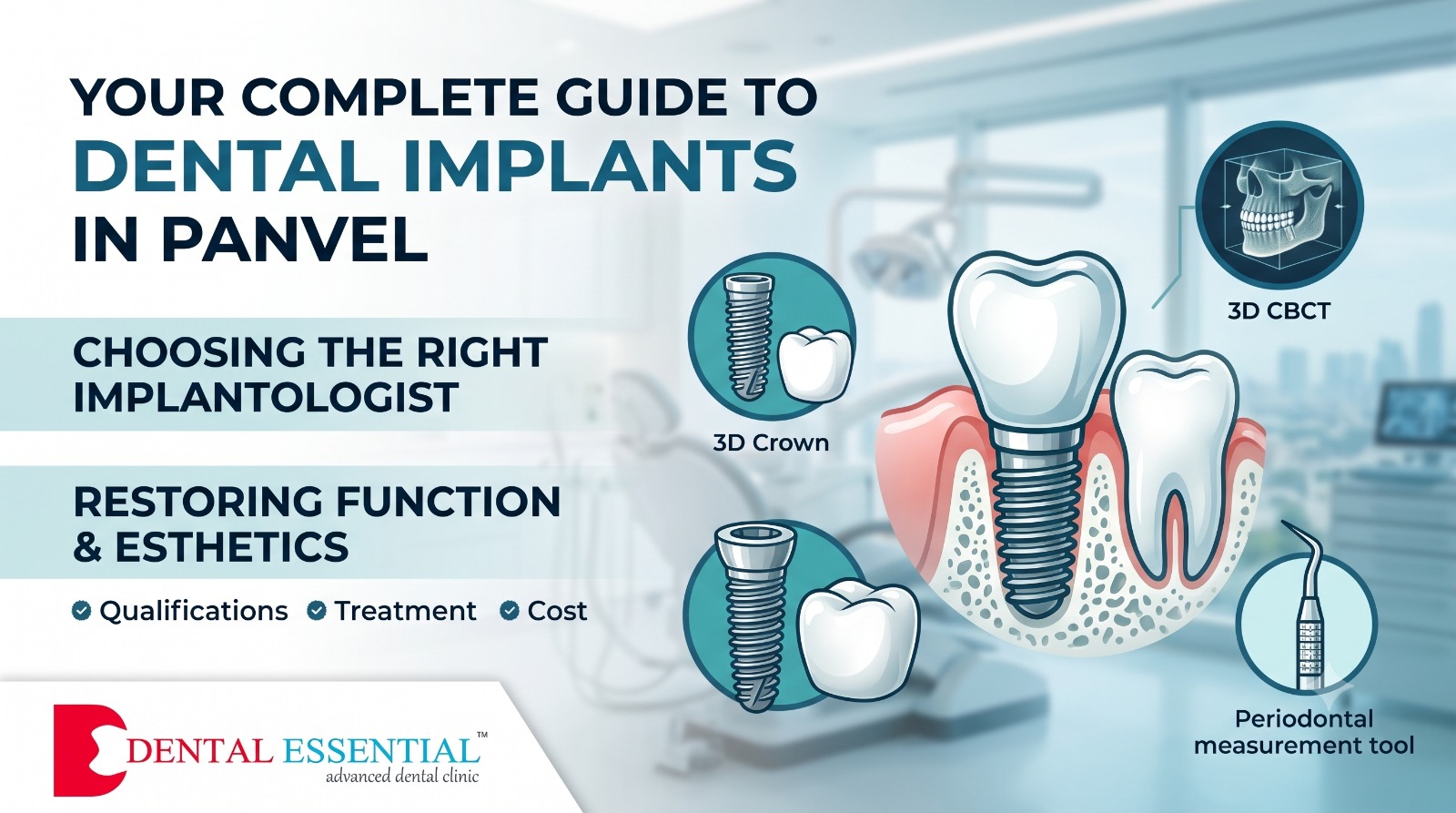
Dental implants are medical devices surgically positioned in the jawbone to support replacement teeth such as crowns, bridges or implant-supported dentures. An implant system generally includes the implant fixture placed in the bone, an abutment or connector and the visible replacement tooth.
Depending on the dentist’s training and the complexity of the case, one dentist may manage the entire treatment or several specialists may work together.
What Does an Implant Dentist Do?
A dental implant specialist may be responsible for much more than the surgical procedure.
The implant dentist’s work can include:
The best implant treatment is planned around the final tooth—not merely around the available bone.
Implant Dentist vs Implantologist: Is There a Difference?
The terms implant dentist and implantologist are commonly used to describe dentists who provide implant treatment.
Neither term alone tells you exactly what postgraduate qualification, training or clinical experience the dentist has.
An implant dentist may have a background in:
Patients should therefore look beyond the title.
Ask about:
Professional implant organisations also advise patients to consider a dentist’s implant credentials and ask detailed questions about training and treatment.
Implant Dentist vs General Dentist
A general dentist provides broad dental care, including:
Some general dentists also receive extensive implant training and provide implant treatment.
An implant dentist has focused knowledge and experience in one or more parts of implant care, including surgery, bone management, implant restoration and maintenance.
A dentist’s job title is less important than:
Implant Dentist vs Prosthodontist
A prosthodontist is a dentist with postgraduate training in restoring and replacing teeth.
Prosthodontists commonly manage:
A dental implant must eventually support a crown, bridge or denture. The implant position must therefore be planned according to the ideal location, size, shape and function of the final tooth.
A prosthodontist with implant training can evaluate both the surgical foundation and the final restorative result.
Implant Dentist vs Oral and Maxillofacial Surgeon
An oral and maxillofacial surgeon has advanced surgical training involving the mouth, jaw and facial structures.
Their possible role in implant treatment includes:
Patients with severe bone loss, complicated anatomy, previous implant failure or significant surgical requirements may benefit from multidisciplinary treatment. Implant Dentist vs Periodontist A periodontist focuses on the gums, jawbone and tissues that support teeth.
Their role may include:
Implant planning may involve a prosthodontist, periodontist, oral surgeon or other professional depending on the patient’s needs.
Why Choosing the Right Implant Dentist Matters
A successful-looking implant is not simply an implant that remains inside the jawbone.
The complete result should ideally be:
Poor planning can lead to problems even when the implant itself integrates with the bone.
Potential concerns include:
Dental implant surgery also carries recognised risks such as infection, injury to surrounding structures, nerve-related symptoms and sinus complications.
This is why clinical assessment and treatment planning matter more than attractive advertisements or the lowest quoted price.
When Should You Consult an Implant Dentist?
Consider consulting a dental implant specialist in Panvel when you:
You can also consult an implant dentist before a damaged tooth is removed. Early planning may help determine whether the tooth can be saved and, when extraction is unavoidable, how the site should be managed for future tooth replacement.
Which Problems Can Implant Dentists Treat?
✦One Missing Tooth
A single dental implant may support an individual crown without requiring the neighbouring healthy teeth to be reduced for a conventional bridge.
✦Several Missing Teeth
Strategically positioned implants may support an implant bridge that replaces several adjacent teeth.
One implant is not necessarily required for every missing tooth.
✦Loose Dentures
Dental implants can provide additional stability for selected removable dentures.
Implant-retained dentures may improve confidence while eating or speaking, but they still require cleaning and maintenance.
✦Complete Tooth Loss
Patients who have lost all or most of their teeth may be assessed for a fixed or removable full-arch implant solution.
These treatments may be marketed under terms such as:
These terms do not represent one universal treatment. The appropriate number, position and type of implants depend on the patient’s bone, bite, medical health and final prosthetic design.
✦Severely Damaged Teeth
A tooth that cannot be restored because of fracture, decay, infection or loss of support may need extraction and replacement.
The implant dentist should first determine whether saving the natural tooth remains a reasonable option.
✦Previous Implant Failure
An experienced implant team can evaluate:
Replacing a failed implant without identifying the cause may repeat the same problem.
Who May Be Suitable for Dental Implants?
Many adults with missing teeth may be considered for implant treatment.
Suitability depends on factors such as:
Overall health can affect healing and implant longevity. Smoking may interfere with healing and reduce long-term implant success, while uncontrolled diabetes can increase the risk of certain complications.
A proper assessment is required before deciding whether someone is a good candidate.
Who May Need Treatment Before Implant Placement?
Implant surgery may need to be delayed or modified when there is:
The aim is not merely to place an implant quickly. The aim is to create an oral environment in which the implant can be maintained.
Do All Implant Patients Need a CBCT Scan?
No. Diagnostic imaging should be selected according to clinical need.
The implant dentist may use:
A CBCT scan provides three-dimensional information about bone and nearby structures. It can be particularly valuable when the dentist must evaluate bone width, nerve location, sinus anatomy or complex implant positions.
However, owning or recommending advanced equipment does not automatically make a dentist more skilled. Technology must be interpreted correctly and integrated into a sound treatment plan.
What Is Prosthetically Driven Implant Planning?
Prosthetically driven planning means deciding the ideal position of the replacement tooth before deciding where to place the implant.
The implant dentist considers:
This is especially important for front-tooth implants, where appearance, gum level and symmetry can be highly visible.
An implant placed in available bone but outside the ideal restorative position may be difficult to restore naturally.
Questions to Ask Implant Dentists Before Treatment
✦1. What Are Your Dental Qualifications?
Ask about:
Do not feel embarrassed about asking. Implant treatment is a surgical and restorative healthcare procedure.
✦2. How Often Do You Perform Implant Treatment?
Years in general dentistry do not automatically equal years of implant experience.
Ask how regularly the dentist manages:
✦3. Have You Treated Cases Similar to Mine?
A routine back-tooth implant is different from:
Relevant experience matters.
✦4. Who Will Perform Each Stage?
Ask who will:
Multidisciplinary treatment can be beneficial, but responsibilities should be clear.
✦5. Can My Natural Tooth Still Be Saved?
An ethical implant dentist should consider whether preserving the natural tooth is still predictable and reasonable.
An implant is a replacement for a missing or non-restorable tooth. It is not automatically better than a healthy natural tooth.
✦6. Do I Have Enough Bone?
When the jawbone is too thin, too soft or inadequate for the intended implant, bone augmentation may be recommended.
Bone grafting can provide a more stable implant foundation, but it may add cost and healing time. Some grafts can be performed during implant placement, while others require a separate healing stage.
✦7. Which Implant System Will Be Used?
Ask for the:
The FDA advises patients to ask which implant brand and model are being used and to retain that information.
This may be useful if the crown or another component needs attention years later.
✦8. What Alternatives Do I Have?
Possible alternatives can include:
A reliable implant dentist should explain reasonable alternatives, including their advantages and limitations.
✦9. What Is Included in the Quoted Cost?
Ask whether the quotation includes:
A low advertised “implant price” may cover only the implant fixture, not the completed replacement tooth.
✦10. What Happens if the Implant Does Not Integrate?
No dentist can honestly guarantee that every implant will succeed.
Ask about:
✦11. How Will the Implant Be Maintained?
Implant treatment does not end when the crown is fitted.
You should receive guidance about:
Regular cleaning and dental reviews are important for long-term implant care.
Red Flags When Comparing Implant Dentists
Be cautious when an implant clinic:
Words such as “advanced,” “premium,” “painless” and “best” are marketing descriptions. They are not substitutes for clinical evidence, qualifications or transparent treatment planning.
Dental Implant Treatment Process
✦Step 1: Consultation and Diagnosis
The implant dentist discusses:
✦Step 2: Oral Examination
The dentist evaluates:
✦Step 3: Diagnostic Records
X-rays, photographs, dental scans or CBCT imaging may be recommended depending on the case.
✦Step 4: Treatment Planning
The treatment plan should explain:
✦Step 5: Oral-Health Preparation
Before implant placement, the patient may need:
✦Step 6: Implant Placement
The implant is surgically placed into the jawbone under local anaesthesia.
The exact procedure depends on:
✦Step 7: Healing and Osseointegration
After placement, the jawbone heals around the implant surface through a process called osseointegration.
Dental implant treatment is commonly completed in stages and the entire process may take several months because time is needed for healing and bone integration.
✦Step 8: Final Implant Crown or Prosthesis
Once the implant is clinically ready, it may support:
✦Step 9: Review and Maintenance
The dentist checks:
Are Same-Day Dental Implants Available?
In selected cases, an implant may be placed immediately after extraction, and a temporary tooth may sometimes be provided during the same treatment phase.
However, “same-day teeth” does not mean:
Immediate implant placement or loading depends on:
Be suspicious of universal same-day promises.
Dental Implant Cost in Panvel
Dental implant cost is influenced by the complete treatment rather than the fixture alone.
Factors affecting the cost include:
Dental Essential’s current implant service starts from approximately ₹20,000 per implant, depending on implant type and case complexity. A personalized quotation is provided after consultation.
This starting figure should not be interpreted as the guaranteed total cost of every completed implant tooth. Why Implant Quotations Differ One quotation may include only:
Another may include:
A more complex quotation may also include:
Compare itemised treatment plans—not one headline number.
Implant Dentist Near Me: Why Location Matters
Dental implant treatment usually requires several stages and follow-up visits.
Choosing an implant dentist near Panvel may make it easier to attend:
For patients managing work, family responsibilities or travel between different parts of Panvel and Navi Mumbai, reliable follow-up access may be more valuable than choosing a distant clinic based only on a promotional price.
Dental Essential serves patients from Panvel, New Panvel, Old Panvel, Kharghar, Kamothe, Kalamboli, Taloja, Ulwe, Khandeshwar and surrounding areas.
Choosing Implant Dentists for Senior Citizens
Older age alone does not automatically prevent implant treatment.
The implant dentist should consider:
For some older adults, stabilising a loose lower denture with implants may improve comfort and chewing. Others may be better served by a well-designed conventional denture.
Treatment should be based on individual benefit and risk—not age alone.
Choosing an Implant Dentist for Full-Mouth Treatment
Full-mouth dental implant treatment is considerably more complex than replacing one tooth.
The dentist must assess:
Before proceeding, ask to see and understand:
A full-arch implant bridge is not maintenance-free.
Dental Implants vs Bridges vs Dentures
| Feature | Dental Implant | Dental Bridge | Removable Denture |
|---|---|---|---|
| Support | Jawbone | Adjacent teeth | Gums and remaining oral structures |
| Surgery | Required | Usually not required | Usually not required |
| Removable | Usually fixed | Fixed | Removable |
| Preparation of adjacent teeth | Usually unnecessary | Commonly required | Not required |
| Bone stimulation | Helps preserve bone around implant | Does not replace the missing root | Does not replace the missing root |
| Cleaning | Requires implant-specific hygiene | Requires cleaning under the bridge | Removed for cleaning |
| Treatment time | Often completed in stages | Usually shorter | Usually shorter |
| Initial cost | Often higher | Usually moderate | Generally lower |
| Suitability | Depends on bone and health | Depends on supporting teeth | Suitable for many patterns of tooth loss |
No option is automatically best for everyone. The implant dentist should help you compare function, maintenance, cost, treatment time and clinical risk.
Caring for Dental Implants
Dental implants cannot develop cavities in the way natural teeth do, but the surrounding gums and bone can become inflamed or infected.
Patients should:
Contact your dentist when you notice:
The FDA recommends contacting the dental provider promptly when an implant feels painful or loose.
Implant Dentists at Dental Essential, Panvel
Dental Essential provides consultations and treatment for missing teeth at its clinic in Vishrali Naka, Panvel.
The clinic is led by Dr. Sameer Ramchandra Gharat, who is listed by Dental Essential as a Prosthodontist and Implantologist with BDS and MDS qualifications in Prosthodontics and Implantology.
The clinic reports that Dr. Sameer has more than 16 years of experience and focuses on:
Dental Essential also states that Dr. Sameer completed his BDS at D. Y. Patil School of Dentistry and later completed an MDS involving Prosthetic Dentistry and Oral Implantology.
A consultation can help determine whether you may benefit from:
The final recommendation depends on your oral health, bone, bite, medical history and expectations.
Frequently Asked Questions About Implant Dentists
✦What is an implant dentist called?
A dentist providing implant treatment may be called an implant dentist or implantologist. Depending on postgraduate training, the dentist may also be a prosthodontist, periodontist or oral and maxillofacial surgeon.
✦What does an implant dentist do?
An implant dentist assesses missing teeth, plans implant positions, places or restores implants, monitors healing and provides long-term maintenance.
✦Which dentist is best for dental implants?
The right dentist depends on your individual case. Compare qualifications, implant-specific training, relevant experience, diagnostic methods, restorative planning, transparency and follow-up care.
✦Can a general dentist perform dental implants?
A general dentist may provide implant treatment when appropriately trained and experienced. Patients should evaluate the dentist’s implant education and experience with similar cases.
✦Is a prosthodontist an implant dentist?
A prosthodontist specialises in replacing and restoring teeth. A prosthodontist who has additional implant training may plan, restore and sometimes surgically place dental implants.
✦Should I choose an oral surgeon or prosthodontist?
Complex surgery may benefit from an oral surgeon, while complex tooth design and bite rehabilitation may benefit from a prosthodontist. Many cases involve collaboration.
✦How do I check an implant dentist’s qualifications?
Ask for the dentist’s degrees, registration details, postgraduate qualifications, implant training and experience with comparable cases.
✦How much does an implant dentist charge in Panvel?
The total fee depends on the implant, surgery, abutment, crown, imaging, grafting and complexity. Dental Essential currently lists implant treatment starting from approximately ₹20,000 per implant, subject to evaluation.
✦Are cheap dental implants safe?
Price alone cannot establish safety or quality. Ask what the quotation includes, which implant system is used, who performs treatment and what follow-up is provided.
✦How long does implant treatment take?
Treatment may take several months because healing and osseointegration require time. Some stages can be combined in selected cases.
✦Is dental implant surgery painful?
Local anaesthesia is used during implant surgery. Temporary soreness, swelling or tenderness may occur afterward. The amount of discomfort depends on treatment complexity.
✦Can an implant dentist provide a tooth in one day?
Some selected patients may receive an immediate implant or temporary tooth. Not everyone is suitable, and final healing still takes time.
✦Do all implant patients need bone grafting?
No. Bone grafting is recommended only when the existing bone cannot support the planned implant position adequately.
✦Are dental implants guaranteed for life?
No responsible dentist can guarantee that every implant will last for life. Longevity depends on health, placement, restoration, oral hygiene, smoking, bite and maintenance.
✦Can smokers receive dental implants?
Treatment may be possible, but smoking can interfere with healing and increase the risk of implant complications.
✦Can diabetic patients receive implants?
Some patients with well-controlled diabetes may be suitable. Medical condition, blood-sugar control, healing risk and oral health must be assessed individually.
✦Can implant dentists replace all teeth?
Yes, implants may support full-arch fixed or removable restorations in suitable patients. Detailed surgical and prosthetic planning is required.
✦How often should implants be checked?
The appropriate review interval depends on the patient’s gum health, hygiene, medical risks and type of restoration. Follow the schedule recommended by your dentist.
Book a Consultation With an Implant Dentist in Panvel
Choosing an implant dentist should not begin and end with searching for the lowest price.
A responsible consultation should help you understand:
✦Contact Details:
- Address: 📍 Shop 16, Bldg 7/B, Gurusharnam Complex, Vishrali Naka, Panvel – 410206
- Phone: 📞 +91 877-9646573
- Clinic Hours: Monday to Saturday: 10:00 AM – 9:30 PM | Sunday: Closed The clinic’s address, telephone number and hours are listed on the official Dental Essential website.
Schedule an implant consultation to receive an individual assessment and compare dental implants with bridges, dentures and other missing-tooth treatment options.
Ready for a Healthier, Straighter Smile?
Consult with expert dentists at Dental Essential Clinic in Panvel. Get personalized treatment plans & affordable care.
Share this article