



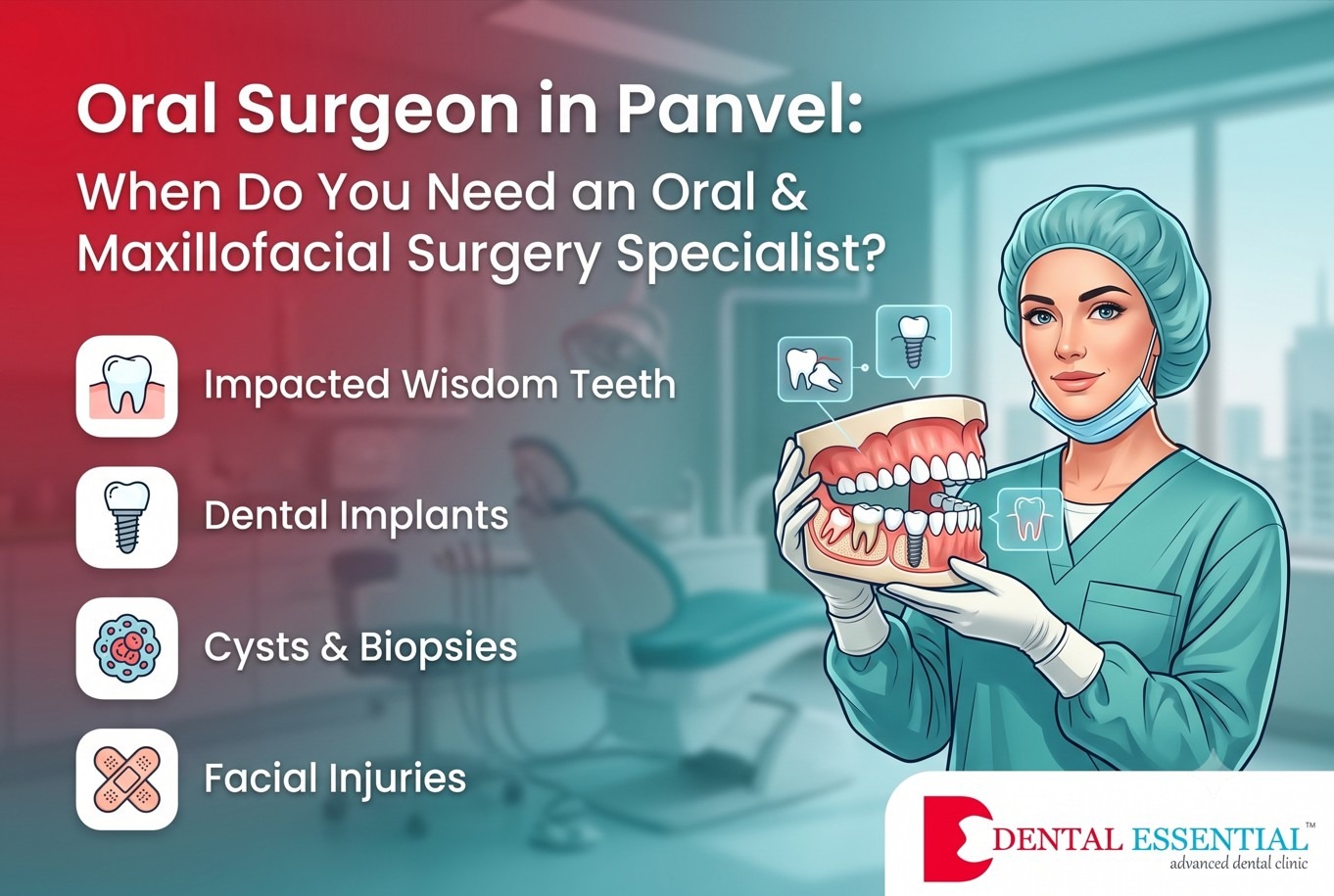
Oral Surgeon in Panvel: When Do You Need an Oral & Maxillofacial Surgery Specialist?
A wisdom tooth is stuck deep inside the jaw.
A badly broken molar cannot be removed with a routine extraction.
Your dentist sees a cyst-like area on an X-ray.
A dental implant needs bone grafting before placement.
Your face or jaw has been injured in an accident.
Or perhaps you were simply told:
“You need an oral surgeon.”
That can immediately sound more serious than an ordinary dental appointment.
But what exactly does an oral surgeon do?
And when should you see an oral and maxillofacial surgeon in Panvel rather than a general dentist?
Oral and Maxillofacial Surgery—commonly abbreviated OMFS—is the recognised dental surgical specialty focused on diseases, injuries and defects affecting the:
India’s postgraduate dental regulations define Oral & Maxillofacial Surgery as the specialty dealing with diagnosis and surgical or adjunctive treatment of diseases, injuries and defects of the jaws and associated oral and facial structures. The MDS curriculum includes both minor and major surgery, impacted teeth, infection management, cyst surgery, fractures, biopsies and maxillofacial trauma.
Internationally, oral and maxillofacial surgeons are similarly described as surgical specialists of the mouth, face and jaws whose scope can include:
Quick Answer: When Should You See an Oral Surgeon?
You may be referred to an oral and maxillofacial surgeon when you have:
A general dentist can manage many routine extractions.
An oral surgeon becomes particularly valuable when the anatomy, surgical difficulty, medical risk or condition itself is more complex.
What Is an Oral Surgeon?
The full specialist title is generally:
Oral and Maxillofacial Surgeon.
“Oral surgeon” is the common shorter term.
India formally recognises MDS – Oral & Maxillofacial Surgery as a postgraduate dental specialty.
The Dental Council curriculum states that the specialty covers diagnosis and management involving the:
In everyday private dental practice, however, many patients encounter oral surgeons primarily for:
impacted wisdom teeth, difficult extractions, implants, bone grafting and jaw-related surgical problems.
Is Every Dentist an Oral Surgeon?
No.
Every qualified dentist receives training in basic dental procedures, including certain tooth extractions.
But oral and maxillofacial surgery is a recognised postgraduate specialty.
A dentist may be able to perform uncomplicated oral-surgical procedures without being an MDS Oral & Maxillofacial Surgeon.
That distinction matters.
The phrase:
“oral surgery”
describes a procedure category.
The phrase:
“oral surgeon”
describes a specialist clinician.
The American Association of Oral and Maxillofacial Surgeons makes the same distinction: not everyone who performs an oral surgical procedure is formally an oral and maxillofacial surgeon.
What Qualification Should an Oral Surgeon Have in India?
If you are specifically searching for an oral and maxillofacial surgeon in Panvel, look for the specialist qualification:
BDS, MDS – Oral & Maxillofacial Surgery
or clearly equivalent recognised postgraduate credentials.
The Indian postgraduate curriculum includes training in:
This is different from simply seeing the words:
“Dental Surgeon”
after a dentist’s name.
Dental Surgeon vs Oral Surgeon: Are They the Same?
This creates a lot of confusion in India.
The term dental surgeon has historically been used broadly for dentists.
That does not automatically mean the dentist is an Oral & Maxillofacial Surgery specialist.
If your concern involves:
verify whether the treating clinician specifically holds an:
MDS in Oral & Maxillofacial Surgery.
That qualification is more informative than a broad “dental surgeon” label.
What Does an Oral and Maxillofacial Surgeon Treat?
The specialty is much broader than wisdom teeth.
✦1. Impacted Wisdom Teeth
This is probably the most common reason patients search:
“oral surgeon near me.”
A wisdom tooth is impacted when it does not erupt normally into the mouth.
It may be:
Impacted wisdom teeth can sometimes cause:
Dental Essential’s current Wisdom Tooth Extraction page specifically lists:
among problems evaluated for wisdom-tooth removal.
✦2. Difficult Tooth Extractions
Not every tooth can be removed through a straightforward extraction.
Surgery may become more complex when a tooth is:
An oral surgeon may need to:
✦3. Dental Implant Surgery
Oral and maxillofacial surgeons may also place dental implants.
The specialist’s surgical training can be useful when the implant case involves:
AAOMS specifically identifies dental implants as a major area of OMS practice and notes that implant training includes diagnosis, site preparation, bone/soft-tissue reconstruction and maintenance.
That does not mean only oral surgeons can place implants.
Implants may also be planned or placed by appropriately trained:
The right professional depends on the case.
✦4. Dental Bone Grafting
Dental implants require adequate supporting bone.
When substantial bone is missing, surgical augmentation may be required.
Bone grafting can involve:
✦5. Sinus Lift / Sinus Augmentation
The maxillary sinus sits above the upper back teeth.
After upper molars are lost, there may not always be enough vertical bone for an implant.
Selected patients may require sinus augmentation to increase available bone.
This is a specialised implant-related surgical procedure.
Not every upper implant needs a sinus lift.
A clinical examination and appropriate three-dimensional imaging may be needed before making that decision.
✦6. Oral and Jaw Cysts
A cyst is a pathological cavity that may occur in the:
Some cysts produce:
Others are discovered accidentally on X-rays.
Indian OMFS postgraduate training specifically includes cyst enucleation and management of oral/maxillofacial pathological conditions.
Treatment depends on:
✦7. Oral Biopsy
A persistent or unusual oral lesion may occasionally require biopsy.
This means removing:
of the suspicious tissue for laboratory examination.
Oral surgeons may perform biopsies involving:
AAOMS includes biopsy of suspicious hard- and soft-tissue lesions within oral-surgical practice.
A biopsy does not automatically mean cancer.
Many oral lesions are benign.
But unexplained persistent lesions should not be diagnosed purely by appearance.
✦8. Facial Trauma and Jaw Fractures
Oral and maxillofacial surgeons can play a major role in treating injuries involving:
The DCI describes maxillofacial trauma management as part of OMFS specialist training and notes collaboration with:
when injuries cross specialty boundaries.
✦9. Corrective Jaw Surgery
Orthognathic surgery corrects significant skeletal problems involving jaw position.
Possible reasons include:
This is generally a hospital-based multidisciplinary treatment involving:
AAOMS identifies corrective jaw surgery as a major OMS treatment area.
✦10. Selected Temporomandibular Joint Problems
The temporomandibular joint—TMJ—connects the lower jaw to the skull.
Most routine jaw clicking or muscle-related jaw pain does not automatically require surgery.
Conservative care is usually considered first.
However, selected severe structural TMJ problems may fall within oral and maxillofacial surgery.
The Indian MDS OMFS curriculum includes the temporomandibular joint within the specialty’s diagnostic and surgical scope.
✦11. Oral Infections Requiring Surgery
Some dental and jaw infections require surgical treatment such as:
The MDS curriculum specifically includes incision and drainage of abscesses and infection management as oral-surgery competencies.
Antibiotics alone may not eliminate the source of a dental infection.
When Do You Need an Oral Surgeon for a Wisdom Tooth?
Not every wisdom tooth needs an oral surgeon.
Some wisdom teeth erupt normally and require no treatment.
Some erupted wisdom teeth can be removed through relatively straightforward extraction.
Specialist surgical care becomes more relevant when the tooth is:
What Does an Impacted Wisdom Tooth Look Like on an X-Ray?
An impacted tooth may appear:
The dentist or surgeon also evaluates:
A two-dimensional X-ray may be sufficient for some cases.
More complex cases may require additional three-dimensional imaging.
Do All Impacted Wisdom Teeth Need Removal?
No.
This is important.
A wisdom tooth should generally be assessed based on:
Surgery should not be recommended simply because the tooth exists.
Signs You Should Have a Wisdom Tooth Checked
Arrange a dental evaluation if you develop:
Dental Essential currently lists these types of symptoms on its wisdom-tooth treatment page.
What Happens During Wisdom Tooth Surgery?
The exact procedure depends on the tooth.
A typical surgical extraction may include:
✦Examination and X-Ray
The dentist or surgeon evaluates:
✦Anaesthesia
Local anaesthesia is commonly used to numb the area.
Other sedation or anaesthesia options may be considered in selected procedures and appropriate clinical settings.
✦Gum Incision
If the tooth is buried, the surgeon may create access through the gum.
✦Bone Removal
A small amount of surrounding bone may sometimes need removal.
✦Tooth Sectioning
Some impacted teeth are divided into smaller pieces.
This can allow more controlled removal.
✦Extraction
The tooth is removed.
✦Cleaning
The surgical area is cleaned.
✦Sutures
Stitches may be placed.
✦Aftercare
You receive instructions covering:
Dental Essential’s own wisdom-tooth workflow currently includes X-ray assessment, anaesthesia, extraction, suturing when needed and postoperative instructions.
Is Wisdom Tooth Surgery Painful?
The procedure is performed using anaesthesia so the surgical area should be appropriately numb during treatment.
After surgery, temporary:
can occur.
Pain experience varies by:
Avoid treating the phrase “painless wisdom tooth surgery” as a literal guarantee.
A better expectation is:
comfortable surgery under appropriate anaesthesia with postoperative discomfort managed according to individual needs.
How Long Does Wisdom Tooth Recovery Take?
Recovery varies.
Dental Essential currently states approximately:
The NHS similarly recommends soft foods during early recovery and warns that complications can include:
The fact that you can return to routine activity does not necessarily mean the extraction socket has completely healed biologically.
What Is Dry Socket?
Dry socket—also called alveolar osteitis—is a painful complication that can occur after extraction.
Normally, a blood clot forms inside the extraction socket.
It protects:
during early healing.
Dry socket occurs when that clot:
Symptoms of Dry Socket
Possible signs include:
Contact your dentist or oral surgeon if pain becomes significantly worse after initially improving.
Does Smoking Increase Dry-Socket Risk?
Yes.
tobacco use as an important dry-socket risk factor because smoking may interfere with healing and suction may dislodge the blood clot.
This is another good reason to follow your surgeon’s postoperative instructions carefully.
What Should You Eat After Oral Surgery?
During early healing, softer food is usually easier.
Panvel-friendly examples can include:
Avoid directing chewing pressure onto the surgical side.
After wisdom-tooth extraction, the NHS advises avoiding hard or crunchy foods and foods such as nuts or seeds that can lodge in the wound.
Follow your surgeon’s individual instructions.
What Should You Avoid After Wisdom Tooth Extraction?
Depending on the procedure, common advice may include temporarily avoiding:
The NHS specifically advises against smoking, alcohol, very hot drinks and hard or crunchy foods during early wisdom-tooth recovery.
When Should You Call the Surgeon After an Extraction?
Seek professional advice if you develop:
The NHS lists uncontrolled bleeding, severe worsening pain/swelling and infection symptoms as reasons for urgent review after wisdom-tooth removal.
When Is Facial Swelling an Emergency?
Facial swelling from dental infection deserves particular attention.
Seek urgent dental assessment for:
Seek emergency medical care if swelling is associated with:
These situations can go beyond routine dental-office management.
Oral Surgeon vs General Dentist
Patients often ask whether they should see a general dentist or an oral surgeon for an extraction or implant. Here is a clear comparison:
| Factor | General Dentist | Oral & Maxillofacial Surgeon (OMFS) |
|---|---|---|
| Primary Scope | Preventive care, routine fillings, basic extractions, standard crowns & cleanings | Advanced surgical procedures involving teeth, jawbones, cysts & facial skeleton |
| Qualification | BDS (Bachelor of Dental Surgery) | MDS (Master of Dental Surgery) in Oral & Maxillofacial Surgery |
| Extractions Handled | Straightforward erupted teeth with intact roots | Deeply impacted wisdom teeth, broken root tips, ankylosed teeth |
| Implant Procedures | Standard single/straightforward implant placement | Complex implants, ridge augmentation, sinus lifts, zygomatic/bone grafts |
| Cysts & Pathology | Identifies lesion on X-ray and refers for surgical diagnosis | Performs surgical enucleation, marsupialisation and biopsy |
| Trauma & Jaw Care | Initial dental first aid, splinting loose teeth | Complex jaw fractures, laceration management, facial trauma surgery |
| Surgical Setting | Routine dental chair | Dental surgical operatory or hospital theatre with specialised sedation |
✦General Dentist May Manage
✦Oral & Maxillofacial Surgeon May Be Needed For
Referral is not a sign that your dentist cannot treat you properly.
Recognising when specialist care adds value is part of responsible dentistry.
Oral Surgeon vs Prosthodontist
A prosthodontist focuses primarily on restoring and replacing teeth.
Treatment includes:
An oral surgeon focuses primarily on surgical treatment.
In a complex implant case:
oral surgeon → may manage extraction, grafting and implant surgery
while:
prosthodontist → may design the implant crown/bridge and overall bite
Dental Essential is led by Dr. Sameer Gharat, a Prosthodontist & Implantologist, BDS, MDS – Prosthodontics & Implantology, with 16+ years of experience.
Complex cases may benefit from collaboration rather than treating one specialty as universally “better.”
Oral Surgeon vs Implantologist
An implantologist is a commonly used term for a dentist with focused implant training and experience.
An oral surgeon is a formally recognised surgical specialist.
Depending on the case, implant treatment may be performed by an appropriately trained:
For straightforward implants, multiple approaches can be appropriate.
For cases involving:
an oral surgeon may play an especially important role.
Oral Surgeon vs Periodontist
A periodontist specialises in:
A periodontist may also perform:
An oral surgeon has a broader surgical scope involving:
Oral Surgeon vs Endodontist
An endodontist specialises primarily in:
An oral surgeon focuses on more extensive surgical conditions.
For example:
An endodontist may try to save a tooth through complex root canal treatment.
An oral surgeon may remove the tooth when it cannot be predictably preserved.
The right specialist depends on the diagnosis.
Oral Surgeon vs ENT Surgeon
Oral and maxillofacial surgery and ENT can overlap around:
The Indian OMFS curriculum specifically describes collaboration with ENT, ophthalmology, neurosurgery, plastic surgery and oncology in complex craniofacial conditions.
The appropriate specialist depends on which anatomical structures are involved.
Oral Surgeon vs Plastic Surgeon
Again, there is overlap in complex facial reconstruction.
Oral surgeons specialise particularly in:
Plastic surgeons may contribute to:
Major trauma frequently requires a team.
Do Oral Surgeons Treat Jaw Fractures?
Yes.
Maxillofacial fracture treatment is an important part of OMFS.
Possible symptoms of jaw fracture include:
Major facial trauma should generally be evaluated in an appropriate hospital setting.
Can an Oral Surgeon Treat a Broken Jaw in a Dental Clinic?
Minor oral surgical procedures can often be performed in dental or ambulatory settings.
Complex facial fractures may require:
A routine dental clinic is not a substitute for a trauma hospital when major injuries are involved.
Can Oral Surgeons Diagnose Oral Cancer?
Oral and maxillofacial surgeons may play a role in:
However, suspected oral malignancy can require coordination between:
A suspicious lesion should be referred appropriately rather than treated as an ordinary mouth ulcer indefinitely.
When Should a Mouth Ulcer Be Checked?
Most simple mouth ulcers heal.
But arrange professional assessment if an ulcer:
Do not self-diagnose persistent lesions.
Can an Oral Surgeon Remove a Dental Cyst?
Yes, depending on:
The Indian OMFS curriculum specifically includes cyst enucleation among clinical surgical procedures.
Some cysts may also require:
Do Oral Surgeons Place Dental Implants?
Yes.
Dental implant surgery falls within the scope of oral and maxillofacial surgery.
But implant treatment is multidisciplinary.
The final implant tooth also requires:
That is why some complex cases involve collaboration between:
Who Is Better for Implants: Oral Surgeon or Prosthodontist?
Neither is automatically “better.”
✦Oral Surgeon May Add Particular Value For
✦Prosthodontist May Add Particular Value For
Some clinicians have substantial training in both implant surgery and restoration.
For complicated cases, teamwork can provide the best combination.
What Is Bone Grafting Before Dental Implants?
Jawbone can shrink after tooth loss.
If there is insufficient bone around the intended implant site, grafting may sometimes be required.
The surgeon assesses:
A graft may be done:
depending on the case.
Does Every Implant Need Bone Grafting?
No.
Many patients have adequate bone.
Do not agree to grafting simply because it appears in a generic implant package.
Ask:
Why do I need grafting?
How was the deficiency measured?
Can you show me on the scan?
What Imaging Does an Oral Surgeon Use?
Depending on the problem, imaging may include:
✦Why CBCT May Matter
CBCT provides three-dimensional information.
For selected procedures, it can help evaluate:
More imaging is not automatically better.
Imaging should be selected because it will influence diagnosis or surgical planning.
Wisdom Tooth and the Inferior Alveolar Nerve
Lower wisdom-tooth roots can sometimes lie close to the nerve that supplies sensation to:
This relationship can make surgery more complex.
The NHS lists temporary or, less commonly, longer-lasting altered sensation of the tongue, lip or chin among recognised wisdom-tooth surgery complications.
Patients with high-risk anatomy should have that risk explained before surgery.
Do You Always Need General Anaesthesia for Oral Surgery?
No.
Many dental surgical procedures are performed using local anaesthesia.
Sedation or general anaesthesia may be considered for selected:
The appropriate setting depends on:
Do not assume that “oral surgeon” automatically means hospital admission.
What Should an Oral Surgery Consultation Include?
A proper surgical consultation can involve several steps.
✦Medical History
Tell the dentist or surgeon about:
✦Dental History
The surgeon asks about:
✦Examination
The clinician checks:
✦Imaging
Relevant radiographs are reviewed.
✦Diagnosis
You should understand:
✦Alternatives
Ask:
✦Surgical Plan
The surgeon should explain:
✦Cost
You should receive a clear estimate before elective treatment.
How Much Does Oral Surgery Cost in Panvel?
There is no single “oral surgery cost.”
A simple extraction and complex maxillofacial surgery are completely different treatments.
Factors include:
Dental Essential’s current Wisdom Tooth Extraction costs approximately:
Simple extraction: ₹1,500–₹3,000 per tooth
Surgical impacted-tooth extraction: ₹4,000–₹12,000 per tooth
These should be treated as current ranges—not a guaranteed quote.
The final price depends on your examination and X-ray.
Why Is One Wisdom Tooth Surgery More Expensive Than Another?
Two wisdom teeth can have completely different difficulty.
Cost can vary because one tooth may be:
while another may be:
More complex surgery can require:
Comparing only:
“wisdom tooth extraction price”
without comparing complexity can be misleading.
Should You Choose the Cheapest Oral Surgeon?
Cost matters.
But the lowest fee should not be your only selection factor when surgery involves:
Compare:
The most expensive surgeon is not automatically the best either.
Choose based on clinical fit and transparency.
How to Choose an Oral Surgeon in Panvel
✦1. Verify the Specialist Qualification
If you specifically need an OMFS specialist, look for:
BDS, MDS – Oral & Maxillofacial Surgery.
Current Panvel/Navi Mumbai provider directories distinguish oral & maxillofacial surgeons using this postgraduate qualification.
✦2. Choose Experience Relevant to Your Procedure
Ask whether the surgeon regularly manages:
depending on what you need.
✦3. Ask How Difficult Your Case Is
A good surgeon should be able to explain the radiograph in understandable language.
✦4. Ask About Important Anatomy
For lower wisdom teeth:
How close is the nerve?
For upper implants:
How close is the sinus?
✦5. Ask About Anaesthesia
Know whether the procedure will use:
✦6. Ask About Alternatives
Surgery should be recommended for a reason.
✦7. Ask What Happens if a Complication Occurs
You should know:
✦8. Review the Follow-Up Plan
Postoperative review is part of surgical care.
✦9. Look Beyond Reviews
Online reviews can tell you about:
They cannot reliably measure:
Use them as one signal.
✦10. Verify Who Will Actually Perform the Surgery
This is especially important in multispeciality clinics.
Ask:
“What is the name and qualification of the surgeon performing my procedure?”
Do not assume the dentist who performs the initial consultation will necessarily perform the surgery.
Red Flags When Choosing an Oral Surgeon
✦“Every Wisdom Tooth Must Be Removed”
Not true.
Treatment should depend on the tooth.
✦“There Is Absolutely Zero Risk”
No surgery is completely risk-free.
✦“100% Painless Recovery”
Anaesthesia controls procedural pain, but postoperative discomfort varies.
✦“No X-Ray Needed”
Surgical extraction should be based on adequate anatomical assessment.
✦“The Nerve Doesn’t Matter”
Lower impacted wisdom teeth can be close to important sensory nerves.
✦No Medical-History Review
Medical conditions can influence surgical planning.
✦No Postoperative Instructions
Aftercare is part of surgery.
✦No Clear Surgeon Identity
If a clinic markets “oral surgeon treatment,” patients should be able to know who the specialist is and what qualification they hold.
Oral Surgery for Children
Children may occasionally need oral surgery for:
Treatment planning can involve collaboration between:
Do not assume adult wisdom-tooth protocols automatically apply to children.
Oral Surgery for Senior Citizens
Older age does not automatically prevent oral surgery.
But planning may require closer attention to:
Bring an accurate medication list to the appointment.
Blood Thinners and Tooth Extraction
Do not stop blood-thinning medication on your own before dental surgery.
The dentist/oral surgeon should review:
When necessary, they may coordinate with the prescribing physician.
The risk of stopping important medication can be greater than the dental bleeding risk.
Diabetes and Oral Surgery
People with diabetes can undergo dental surgery, but healing and infection risk can be influenced by:
Tell your surgeon about your diabetes and medications.
Do not hide medical history because you are worried the procedure will be postponed.
Safe planning matters more than speed.
Oral Surgery and Smoking
Smoking can impair wound healing and increase complications after extraction.
It is particularly relevant to dry-socket risk.
Follow your surgeon’s instructions on avoiding tobacco around surgery.
Oral Surgery and Everyday Life in Panvel
Panvel is home to:
That affects practical treatment planning.
Patients often ask:
“Can I go to work the next day?”
“Can I schedule wisdom-tooth surgery on Saturday?”
“Will swelling be gone before my meeting?”
“Can I have surgery just before a wedding?”
Those are sensible questions.
The answer depends on:
A simple extraction and a deeply impacted wisdom tooth are not the same recovery experience.
Planning Wisdom Tooth Surgery Around Work or College
If your job involves:
consider allowing some recovery flexibility after surgical extraction.
Swelling commonly becomes noticeable during the first few postoperative days.
Do not schedule major surgery based on the assumption that you will definitely look and feel normal the next morning.
Oral Surgery Before Weddings and Festivals
Patients sometimes want a painful wisdom tooth removed immediately before:
Emergency infection may need treatment regardless of timing.
But elective surgery should be planned sensibly.
Allow time for:
Traditional Foods After Oral Surgery
You do not need culturally unrealistic food advice after surgery.
Soft familiar options can work well.
During early healing, you may choose foods such as:
The key is:
soft texture + comfortable temperature + avoid the surgical site.
Avoid hard nuts and seeds during early healing because particles can enter the socket.
Cost and Access to Oral Surgery in Panvel
People in Panvel have different:
That should influence how treatment is explained, not assumptions about who deserves specialist care.
A responsible treatment plan should distinguish:
emergency care
from:
necessary elective surgery
and explain:
For cost-conscious patients, earlier treatment can sometimes prevent a manageable wisdom-tooth or dental infection from becoming a larger emergency.
Religion, Caste, Community and Politics Do Not Determine Surgical Risk
Oral surgery risk depends on factors such as:
It does not depend biologically on:
Interestingly, the Indian OMFS postgraduate curriculum explicitly says surgical care should be delivered irrespective of social status, caste, creed or religion, while recognising that genuine social and economic factors can affect disease management and access to care.
That is the responsible way to localise healthcare content.
Oral Surgery Facilities Around Panvel and Navi Mumbai
Panvel and Navi Mumbai have both:
For example, MGM Dental College & Hospital has an Oral & Maxillofacial Surgery department with:
and reports management of complex craniofacial trauma.
This distinction matters:
routine oral surgery can often be managed in an appropriate dental setting.
major facial trauma and complex maxillofacial surgery may require hospital-based care.
Oral Surgery at Dental Essential, Panvel
Dental Essential currently provides wisdom tooth extraction in Panvel for concerns including:
Its current service page states that oral surgeons perform problematic wisdom-tooth extractions using surgical techniques and appropriate anaesthesia.
The clinic’s broader treatment range also includes:
For patients whose condition requires oral surgery, the appropriate clinician should be selected according to the diagnosis and procedure complexity.
About Dental Essential’s Current Team
Dental Essential is led by:
For a specialist page targeting “oral surgeon in Panvel,” the actual Oral & Maxillofacial Surgeon performing Dental Essential’s surgical cases should also be clearly identified on the website.
Dental Essential – Advanced Dental Clinic in Panvel
These details are confirmed on Dental Essential’s current official contact page.
Areas Served
Dental Essential currently lists patients from:
Final Takeaway
An oral surgeon in Panvel is not simply a dentist who removes teeth.
The recognised specialty—Oral & Maxillofacial Surgery—covers surgical problems involving:
teeth,
mouth,
jawbones,
and facial structures.
You may benefit from an Oral & Maxillofacial Surgeon when you have:
For a straightforward tooth extraction, specialist surgery may not always be necessary.
The key is matching the complexity of the problem to the right clinician.
If you are considering wisdom tooth removal, impacted tooth surgery, complex dental extraction or other oral surgery in Panvel,
Contact: Dental Essential – Advanced Dental Clinic
📍 Address: Shop 16, Bldg 7/B, Gurusharnam Complex, Vishrali Naka, Panvel – 410206
📞 Phone: +91 877-9646573
⏰ Clinic Hours: Monday – Saturday: 10:00 AM – 2:00 PM & 5:00 PM – 9:00 PM | Sunday: Closed
Before scheduling surgery, ask:
Frequently Asked Questions About Oral Surgeons
✦What is an oral surgeon?
An oral surgeon—more formally an oral and maxillofacial surgeon—is a dental surgical specialist trained to diagnose and surgically treat diseases, injuries and defects affecting the mouth, jaws and associated facial structures.
✦What qualification does an oral surgeon have in India?
A formally trained specialist commonly holds:
BDS, MDS – Oral & Maxillofacial Surgery.
✦Is an oral surgeon the same as a dental surgeon?
Not necessarily.
“Dental surgeon” can be a broad term for a dentist.
Oral and maxillofacial surgery is a specific postgraduate specialty.
✦Is oral surgeon the same as maxillofacial surgeon?
“Oral surgeon” is commonly used as the shorter term.
The complete specialist title is Oral and Maxillofacial Surgeon.
✦What does a maxillofacial surgeon do?
The specialty includes surgery involving:
Depending on training and setting, this can include wisdom teeth, implants, cysts, jaw surgery and facial trauma.
✦When should I see an oral surgeon?
You may need one for:
✦Do I need an oral surgeon to remove every wisdom tooth?
No.
Some wisdom teeth require no treatment, while uncomplicated erupted wisdom teeth may be removed by a general dentist.
✦Who removes impacted wisdom teeth?
Impacted teeth are commonly managed by dentists with appropriate surgical training or an oral and maxillofacial surgeon, particularly when the impaction is complex.
✦How do I know whether my wisdom tooth is impacted?
A clinical examination and dental X-ray can show whether the tooth is:
✦Does an impacted wisdom tooth always hurt?
No.
Some impacted teeth remain asymptomatic.
✦Should painless wisdom teeth be removed?
Not automatically.
The decision should consider:
✦What are signs of wisdom-tooth infection?
Possible symptoms include:
✦Is wisdom-tooth removal painful?
The procedure is normally performed under anaesthesia.
Postoperative soreness and swelling can occur.
✦How long is wisdom-tooth recovery?
Dental Essential currently states roughly 3–5 days for many simple extractions and up to 1–2 weeks for complete recovery after surgical extraction, although individual healing varies.
✦What is dry socket?
Dry socket occurs when the protective blood clot in an extraction socket is lost or fails to form properly, exposing underlying bone and nerves.
✦How do I know if I have dry socket?
Severe pain beginning a few days after extraction, particularly pain radiating into the jaw or ear, can be a warning sign.
✦Does smoking cause dry socket?
Smoking increases dry-socket risk and may interfere with healing.
✦Can I eat normally after wisdom-tooth surgery?
You will usually need softer foods during early recovery.
Avoid hard foods and small pieces that can enter the socket until healing progresses.
✦Can an oral surgeon place dental implants?
Yes.
Dental implant surgery falls within OMFS practice.
✦Is an oral surgeon better than an implantologist?
Not universally.
The ideal clinician depends on:
✦Is an oral surgeon better than a prosthodontist for implants?
They have different strengths.
An oral surgeon may focus strongly on surgery and grafting.
A prosthodontist may focus strongly on final tooth replacement and bite planning.
Complex cases may involve both.
✦Can an oral surgeon perform bone grafting?
Yes.
Bone grafting and reconstructive jaw procedures can fall within oral and maxillofacial surgery.
✦What is a sinus lift?
A sinus lift is a bone-augmentation procedure used in selected upper-jaw implant cases when insufficient bone exists below the maxillary sinus.
✦Does every implant patient need a sinus lift?
No.
It depends on available bone and anatomy.
✦Can an oral surgeon treat a dental abscess?
Oral surgeons may treat infections requiring surgical procedures such as drainage or extraction.
✦Can an oral surgeon remove a jaw cyst?
Yes.
Cyst surgery is included within formal OMFS training.
✦Does every oral cyst need surgery?
No.
Treatment depends on the diagnosis, size and behaviour of the lesion.
✦Can an oral surgeon perform a biopsy?
Yes.
Biopsy of oral and jaw lesions falls within oral-surgical practice.
✦Can an oral surgeon treat facial trauma?
Yes.
Oral and maxillofacial surgeons have specialised training in facial and jaw injuries.
✦Who treats a broken jaw?
Oral and maxillofacial surgeons are among the specialists involved in jaw-fracture treatment, usually in an appropriate hospital setting.
✦Can a jaw fracture be treated in a normal dental clinic?
Major jaw fractures commonly require hospital-based care and appropriate surgical facilities.
✦Does an oral surgeon treat TMJ?
Selected structural or surgical TMJ conditions may fall within OMFS.
Most jaw clicking or muscle-related pain does not automatically need surgery.
✦Does an oral surgeon treat oral cancer?
OMFS may be involved in biopsy and surgical management of oral/head-and-neck pathology, usually within multidisciplinary care.
✦Can an oral surgeon remove a broken root?
Yes.
Difficult retained roots are common oral-surgical referral problems.
✦Does a surgical extraction require stitches?
Sometimes.
It depends on the surgical approach and wound.
✦Do stitches need to be removed?
Some sutures dissolve.
Others require removal.
Your surgeon will tell you which type was used.
✦Do I need general anaesthesia for wisdom-tooth surgery?
Usually not automatically.
Many procedures are performed under local anaesthesia.
Sedation or general anaesthesia may be used in selected cases and appropriate facilities.
✦Is it safe to have several wisdom teeth removed together?
It can be appropriate for selected patients.
The decision depends on:
✦Should I stop blood thinners before oral surgery?
Never stop prescribed anticoagulant or antiplatelet medication on your own.
Discuss it with the surgeon and prescribing physician when necessary.
✦Can diabetic patients have oral surgery?
Yes, many can.
Planning should consider diabetes control, healing and infection risk.
✦How much does wisdom-tooth surgery cost in Panvel?
Dental Essential currently lists approximately:
Your individual cost depends on examination and surgical complexity.
✦How do I choose an oral surgeon in Panvel?
Check:
✦Should I choose an oral surgeon based only on reviews?
No.
Reviews can help assess patient experience, but they should not replace verification of qualifications and procedure-specific experience.
✦What should I ask before wisdom-tooth surgery?
Ask:
✦Where can I get wisdom-tooth surgery in Panvel?
Dental Essential provides wisdom-tooth assessment and surgical extraction at:
📍 Address: Shop 16, Bldg 7/B, Gurusharnam Complex, Vishrali Naka, Panvel – 410206
📞 Phone: +91 877-9646573
Ready for a Healthier, Straighter Smile?
Consult with expert dentists at Dental Essential Clinic in Panvel. Get personalized treatment plans & affordable care.
Share this article