



Complete Guide to Invisalign in Panvel: Cost, Procedure & Candidacy
You want straighter teeth.
But you do not particularly want:
metal brackets,
visible wires,
food restrictions,
or braces appearing in every office meeting, college photograph, wedding function and family picture for the next year or two.
That is exactly why searches for Invisalign in Panvel, clear aligners, invisible braces and teeth aligners have increased as adults and teenagers look for a more discreet way to straighten their teeth.
But before choosing Invisalign because the trays look almost invisible, there is a more important question:
Is Invisalign actually the right orthodontic treatment for your bite?
Invisalign® is a brand of doctor-directed clear-aligner orthodontic treatment developed by Align Technology.
Instead of using fixed brackets and wires, Invisalign treatment uses a sequence of custom-made removable aligners to gradually move teeth according to a digitally planned treatment sequence.
The official Invisalign system includes technologies such as ClinCheck® treatment-planning software, SmartTrack® aligner material and SmartForce® features or attachments used in selected cases to help control tooth movement.
However, an important distinction comes first:
Invisalign is not the same thing as every clear aligner.
“Invisalign” is a specific brand.
“Clear aligners” describe the overall orthodontic treatment category.
And “invisible braces” is mainly a popular consumer search term—clear aligners are discreet, but they are not literally invisible.
Quick Answer: What Is Invisalign?
Invisalign is a doctor-directed orthodontic system that uses a series of customised clear removable aligners to gradually reposition teeth.
You usually:
Invisalign’s official Indian patient guidance recommends wearing aligners 20–22 hours daily and states that review appointments commonly occur approximately every 6–8 weeks, although the schedule is determined by the treating doctor.
The American Association of Orthodontists similarly explains that clear aligners work by sequentially applying controlled pressure to reposition teeth and that aligners are not appropriate for every orthodontic problem.
Invisalign vs [Clear Aligners](/services/clear-aligners): Are They the Same?
No.
✦[Clear Aligners](/services/clear-aligners)
“Clear aligners” is the general category.
Several companies manufacture transparent removable orthodontic trays.
✦Invisalign
Invisalign is one particular clear-aligner system.
The system currently uses proprietary technologies including:
✦Invisible Braces
“Dental invisible braces” or “invisible braces” are common consumer search phrases.
Technically:
traditional braces = brackets + wires
while:
clear aligners = removable trays.
So if you search:
invisible braces in Panvel
make sure you understand which treatment the clinic is actually offering.
How Does Invisalign Work?
The aligners may look simple.
The biology underneath them is not.
Orthodontic tooth movement happens because carefully controlled forces cause the tissues and bone surrounding teeth to remodel.
That means Invisalign treatment should begin with:
diagnosis—not simply scanning your teeth and ordering trays.
✦Step 1: Orthodontic Consultation
Your dentist or orthodontist evaluates:
The clinician should determine:
What is the orthodontic diagnosis?
before asking:
Which aligner should we order?
✦Step 2: Dental and Orthodontic Records
Depending on your case, assessment may include:
This step matters because a three-dimensional surface scan shows the visible shape of your teeth but cannot show everything below the gum line.
The AAO emphasises that in-person examination and appropriate radiographs can be important for evaluating:
before orthodontic tooth movement.
✦Step 3: Digital Tooth Scan
The official Invisalign workflow uses three-dimensional digital records to create a model of your teeth.
Invisalign’s own system describes use of iTero scanning in its standard digital workflow.
However, do not assume that every Invisalign clinic uses the same scanner.
That distinction should remain accurate in the published article.
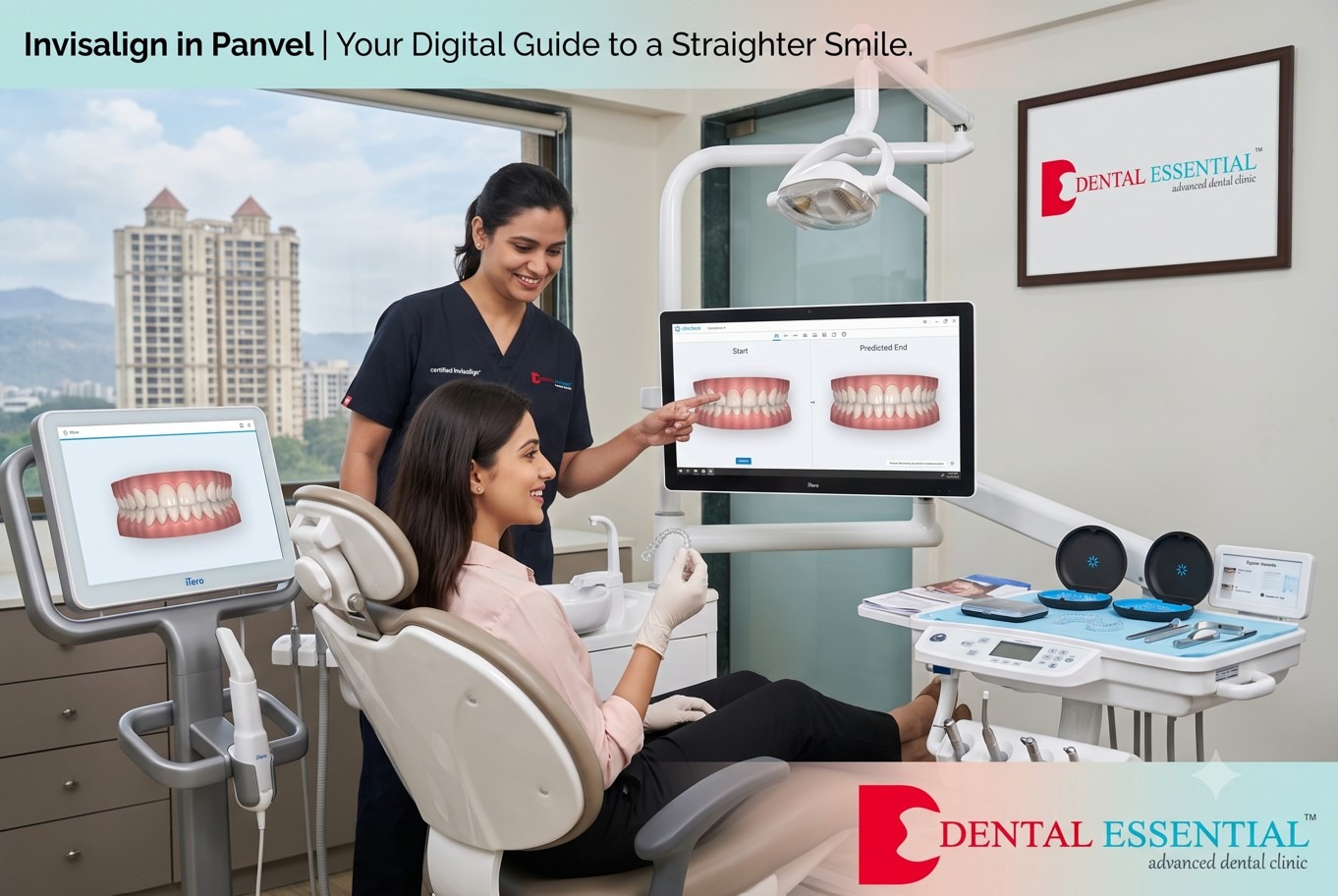
✦Step 4: ClinCheck Treatment Planning
For Invisalign treatment, the clinician can use ClinCheck software to review and customise proposed tooth movements.
The software visualises:
Invisalign states that the treating practitioner remains responsible for clinical decisions and for designing and prescribing the appropriate treatment plan.
That is an important point.
The software does not replace the orthodontist or dentist.
A digital simulation is a treatment-planning tool—not a guarantee that every tooth will move exactly as predicted.
✦Step 5: Your Custom Aligners Are Made
A sequence of trays is manufactured according to the approved plan.
Each aligner represents one stage of tooth movement.
You move through the series according to the schedule prescribed by your treating clinician.
Some plans change aligners:
depending on the clinical situation.
A 2024 systematic review found no universally superior change interval across all types of tooth movement, reinforcing the importance of clinician-directed wear protocols rather than changing trays faster simply to finish treatment sooner.
✦Step 6: Wear Invisalign 20–22 Hours Per Day
This is where patient behaviour becomes critical.
Invisalign’s current instructions recommend approximately:
20–22 hours of daily wear.
You generally remove aligners for:
If aligners spend six or eight hours each day sitting in their case, the biology cannot follow the treatment plan properly.
✦Step 7: Progress Reviews
Invisalign recommends periodic professional monitoring and says review visits are commonly scheduled approximately every 6–8 weeks, although the treating doctor sets the schedule.
These visits allow the clinician to check:
The AAO also stresses that in-person monitoring remains important even with digitally planned orthodontic treatment.
✦Step 8: Refinement Aligners When Needed
Digital treatment does not mean every tooth always reaches the planned position perfectly after the first sequence.
Sometimes additional scans and refinement aligners are required.
Refinements are not necessarily a sign that treatment failed.
They can be part of fine-tuning the result.
Dental Essential’s current Invisalign article already identifies refinement aligners as one factor that can influence the treatment process and cost.
✦Step 9: Retainers
When active tooth movement ends, treatment is not finished forever.
Your teeth can shift again.
Retainers help maintain the new position.
The AAO’s current guidance states that retention is an essential part of orthodontic treatment and that some degree of lifelong retainer wear is commonly required if patients want to maintain their alignment.
That means the complete Invisalign journey is:
aligners → finishing/refinement → retainers → long-term retention.
What Can Invisalign Treat?
Invisalign can be used for many orthodontic problems.
However, suitability depends on:
✦Crooked Teeth
Rotated or irregular teeth may be gradually repositioned using clear aligners.
✦Crowded Teeth
Crowding occurs when there is insufficient space for the teeth to align.
Invisalign’s official treatment portfolio includes cases involving dental crowding.
✦Gaps Between Teeth
Spacing or diastema can often be managed with orthodontic aligners depending on the underlying cause.
Invisalign currently displays treatment examples for spacing.
✦Overbite
An overbite describes vertical overlap of the upper and lower front teeth.
Some degree of overbite is normal.
Selected excessive overbites can be treated using Invisalign, depending on:
✦Underbite
Selected underbite cases can be treated using clear aligners.
More significant skeletal underbites may require different orthodontic or multidisciplinary approaches.
✦Crossbite
Clear aligners can be used to manage selected crossbite problems.
✦Open Bite
An open bite occurs when selected upper and lower teeth do not contact when the mouth closes.
Invisalign publishes treatment examples involving open-bite correction, although individual predictability varies according to the type of movement required.
✦Teeth That Shifted After Previous Braces
This is a strong Invisalign search-intent cluster.
If you previously had braces but stopped wearing your retainer, teeth may gradually shift.
Selected orthodontic relapse cases may be suitable for a shorter clear-aligner treatment.
But do not simply restart an old retainer if it no longer fits properly.
Have the teeth assessed first.
Does Invisalign Work?
Yes—when:
But “works” does not mean:
every planned movement is 100% predictable.
That distinction is essential.
A 2023 review of clear-aligner research found that clear aligners can effectively improve several types of malocclusion, particularly mild-to-moderate crowding, but certain movements—such as:
were generally less predictable than simpler tipping movements.
A newer systematic review focusing on Invisalign likewise concluded that outcomes depend on a combination of:
Do not tell patients:
“digital treatment means guaranteed predictable results.”
A more accurate statement is:
Is Invisalign Better Than Other Clear Aligners?
Not automatically.
Invisalign has a mature digital treatment ecosystem and proprietary technologies.
But treatment outcome depends heavily on:
The brand cannot compensate for:
When comparing clear-aligner brands, ask:
Invisalign vs Braces: Which Is Better?
Neither is universally better.
The AAO specifically advises that there is no single correct appliance for every orthodontic problem. Diagnosis should determine whether braces, aligners or a combination of approaches is most appropriate.
| Feature / Factor | Invisalign (Clear Aligners) | Traditional Fixed Braces |
|---|---|---|
| Visibility & Aesthetics | Discreet, nearly invisible transparent SmartTrack® trays | Noticeable metal or ceramic brackets & archwires |
| Removability | 100% Removable for meals, brushing, photos & social events | Fixed; only removed by orthodontist at end of treatment |
| Dietary Restrictions | None (remove aligners to enjoy all your favorite foods) | Must avoid hard, sticky, crunchy, or fibrous foods |
| Oral Hygiene & Flossing | Normal brushing & flossing without obstructions | Requires specialized floss threaders & interdental brushes |
| Patient Compliance | High discipline required (Must wear 20–22 hours daily) | Works automatically 24/7 without patient remembering |
| Discomfort & Irritation | Smooth plastic; no metal cuts or broken archwires | Wire pokes, bracket rubbing, oral ulceration risks |
| Complex Bite Corrections | Highly effective for mild, moderate, and many severe cases | Preferred for severe skeletal discrepancies and impactions |
| Follow-Up Visits | Fewer clinic visits (typically every 6–8 weeks) | Regular appointments every 4–5 weeks for wire tightening |
| Post-Treatment Retainers | Required (Vivera or custom clear retainers) | Required (Clear retainers or fixed lingual bonded wire) |
✦Invisalign May Suit You if You Prioritise
✦Braces May Be More Practical if
Who Is a Good Candidate for Invisalign?
You may be a suitable candidate if you:
Who May Not Be an Ideal Candidate?
Invisalign may be delayed, modified or replaced with another treatment when:
The AAO and NHS specialist guidance both emphasise that orthodontic treatment should begin only when teeth and gums are healthy enough for controlled movement.
Why Gum Health Matters Before Invisalign
A clear tray can look harmless.
But Invisalign moves teeth through bone.
If periodontal support around those teeth is unhealthy, movement can potentially contribute to:
That is why a digital scan alone should never replace an oral-health evaluation.
Why Cavities Should Be Treated Before Invisalign
Aligners cover the tooth surface for many hours every day.
Untreated:
should be addressed before beginning elective orthodontic treatment.
Good oral health helps make orthodontic treatment safer and easier to manage.
Invisalign Attachments: What Are the Little Bumps on the Teeth?
Many patients are surprised to discover that Invisalign treatment may involve small tooth-coloured attachments.
These are usually bonded to selected teeth.
Their purpose is to give the aligner extra control over certain tooth movements.
The AAO notes that tooth-coloured attachments are frequently used during clear-aligner therapy, while Invisalign uses proprietary SmartForce features in selected treatment designs.
Attachments can help with movements such as:
Does Having Attachments Make Invisalign Visible?
A little.
The trays remain clear, but attachments can make the appliance easier to notice at close range.
This is why the phrase:
“completely invisible braces”
is misleading.
A more accurate term is:
discreet or virtually invisible orthodontic treatment.
What Is IPR in Invisalign Treatment?
IPR stands for interproximal reduction.
It involves carefully reducing a very small amount of enamel between selected teeth to create space when clinically necessary.
It may be used for:
IPR is not required in every Invisalign case.
The amount, location and safety should be planned by the treating clinician.
Dental Essential’s current Invisalign guide already identifies IPR as one possible adjunctive procedure.
Do Invisalign Patients Need Elastics?
Some do.
Orthodontic elastics may be used alongside aligners to help correct selected bite relationships.
The AAO confirms that clear aligners can be combined with orthodontic elastics in suitable cases.
If elastics are prescribed, wearing them correctly becomes another important part of treatment compliance.
What Are Invisalign Refinements?
Imagine finishing your planned aligner sequence and discovering that:
Your clinician may rescan the teeth and order additional aligners.
This is called:
refinement.
Ask before beginning treatment:
Are refinement aligners included in my quoted fee?
This can make a substantial difference when comparing Invisalign prices.
How Long Does Invisalign Treatment Take?
There is no single timeline for every patient.
The official Invisalign India FAQ currently states that average adult treatment is approximately 12–18 months, while individual duration depends on the patient’s specific needs.
Some relatively limited treatments may take less time.
More complex cases can take considerably longer.
Avoid relying on generic promises such as:
“Invisalign straightens every smile in six months.”
The official Invisalign website says some patients may begin to see changes in as little as six months.
That is not the same as saying every treatment is finished in six months.
✦Treatment Time Depends on
Can Invisalign Work Faster Than Braces?
Sometimes.
But speed should not be used as a universal selling point.
The appliance that completes one patient’s treatment faster may not be the best appliance for another patient.
The AAO recommends selecting the appliance according to:
How Many Hours a Day Should You Wear Invisalign?
Current Invisalign guidance recommends:
20–22 hours every day.
That leaves approximately two to four hours in total for:
This becomes particularly important in real life.
Invisalign and Panvel’s Chai, Coffee and Snack Routine
For someone whose day includes:
Invisalign requires behavioural discipline.
Every time you remove the trays, the clock keeps running.
You cannot simply say:
“I’ll wear them while drinking tea.”
Invisalign’s current instructions recommend removing aligners for beverages other than cool water because coloured/sugary liquids can:
and hot beverages may distort the aligner material.
For Panvel professionals and commuters, one of the most practical Invisalign strategies is often to consolidate unnecessary snacking and tea breaks so you can maintain prescribed wear time.
That is much more useful than pretending aligners require no lifestyle changes.
What Can You Eat With Invisalign?
Because the aligners are removed during meals, there are generally no fixed-brace-style food restrictions.
You can continue eating normal foods such as:
The important rule is:
remove the aligners before eating.
Then clean your teeth appropriately before reinserting them.
Invisalign’s official FAQ says patients can generally continue eating their normal foods because aligners are removed for meals.
Can You Drink Tea or Coffee With Invisalign?
Ideally, remove the aligners.
Invisalign recommends drinking only cool water while the trays are in place.
Tea and coffee can contribute to:
and very hot beverages may deform the trays.
Can You Drink Alcohol With Invisalign?
The safest practical rule is still:
remove aligners for drinks other than water.
If you drink any sugary, acidic or coloured beverage:
How Should You Clean Invisalign Aligners?
Good cleaning helps prevent:
Basic care includes:
Do not use very hot water.
It may distort the aligner and affect fit.
Can You Brush Invisalign With Toothpaste?
Some toothpastes can be abrasive enough to make clear plastic appear cloudy.
Follow the cleaning method recommended by your treating provider or Invisalign’s current product instructions rather than aggressively scrubbing the trays.
Does Invisalign Hurt?
Orthodontic movement involves pressure.
So Invisalign should not be advertised as:
“completely painless.”
When switching to a new tray, some people experience temporary:
The absence of metal wires may reduce certain kinds of cheek or lip irritation, but Invisalign still moves teeth biologically.
Is Invisalign More Comfortable Than Braces?
Many patients perceive clear aligners as more comfortable because they do not have:
But comfort is subjective.
The official Invisalign website makes comfort comparisons based partly on manufacturer-supported evidence; patient experience can vary.
A responsible clinic should say:
“Many patients find aligners comfortable and convenient,”
rather than:
“Invisalign is painless for everyone.”
What Are the Disadvantages of Invisalign?
A balanced page should discuss limitations honestly.
✦Invisalign Requires Excellent Compliance
Removability is both its biggest advantage and biggest weakness.
If you do not wear the trays:
the treatment does not happen as planned.
✦Aligners Can Be Lost
One lunch napkin can become a surprisingly expensive bin bag.
Always use the case.
✦Attachments May Be Needed
You may still have small bonded features visible on the teeth.
✦Refinements May Be Needed
The first digital treatment plan is not always the final aligner sequence.
✦Complex Movements Can Be Less Predictable
Research suggests that some:
can be more difficult to reproduce exactly with clear aligners.
✦You Still Need Professional Monitoring
Aligners are orthodontic medical treatment—not simply cosmetic plastic trays.
✦Treatment Can Cost More Than Basic [metal braces](/services/braces)
Cost varies substantially according to system and complexity.
What Are the Risks of Invisalign?
Invisalign is an orthodontic treatment, so general orthodontic risks still apply.
Possible concerns include:
Specialist NHS guidance identifies:
among recognised orthodontic risks generally.
Clear aligners reduce some problems associated with fixed brackets, but they do not remove the biological risks of moving teeth.
Can Invisalign Damage Tooth Roots?
Orthodontic movement can cause some root shortening.
For most patients this is limited, but certain individuals are at greater risk.
That is another reason proper:
matters.
Can Invisalign Cause Gum Recession?
Orthodontic tooth movement can sometimes contribute to gum recession, especially where periodontal support is already compromised.
The AAO specifically warns that moving teeth in patients with poor gum or bone health can lead to:
Patients with periodontal problems may need gum treatment before orthodontics begins.
Can Invisalign Cause Cavities?
The aligner itself does not create cavities.
The problem arises when:
remain trapped against the teeth under the trays.
This is why brushing before reinsertion and removing the trays for drinks other than water matters.
Invisalign for Adults
Adults are one of the strongest commercial-intent groups for this page.
Many adults consider Invisalign because they:
Adults can undergo orthodontic treatment when:
are healthy enough for movement.
Age itself is not the primary limiting factor.
Invisalign for Working Professionals in Panvel
For professionals commuting between:
the main attractions can include:
However, commuting creates its own challenges.
If you remove your aligners at:
wear time can quietly fall well below the recommended 20–22 hours.
Your routine matters.
Invisalign for College Students
Clear aligners can appeal to students who want:
But removable treatment requires responsibility.
A student who frequently:
may actually do better with fixed braces.
The fashionable option is not necessarily the practical option.
Invisalign for Teenagers
Invisalign treatment can be used in suitable teenage orthodontic cases.
The system has treatment options specifically developed for teenagers and growing patients.
But teenagers need to be willing to:
Parents should consider the teenager’s habits—not just appearance preference.
Can Children Use Invisalign?
Invisalign currently offers Invisalign First™, designed for selected children approximately 6–10 years old, as part of Phase 1 orthodontic treatment.
However:
that does not mean every six-year-old needs Invisalign.
Nor does it confirm that every Invisalign provider offers Invisalign First.
Invisalign Before a Wedding
This is highly relevant for Panvel/Navi Mumbai searches.
Many patients begin looking for:
Invisalign before wedding
clear aligners for bride
invisible braces for groom
because they do not want visible braces in:
Invisalign can be discreet during treatment.
But:
do not begin treatment three months before a wedding assuming your teeth will definitely be finished by then.
Some patients may see changes quickly, but complete treatment often takes considerably longer. Invisalign’s own FAQ places average adult treatment around 12–18 months.
Start planning early.
Invisalign During Ganeshotsav, Diwali and Family Functions
One practical benefit of removable aligners is that you can enjoy normal foods when the trays are removed.
You do not need to avoid:
because brackets could break.
But frequent festival snacking creates a different problem:
wear time.
Remove the trays to eat.
Clean your teeth appropriately.
Then put them back.
Do not let a week of celebrations become a week of 12-hour aligner wear.
Social, Religious or Community Identity Does Not Determine Invisalign Suitability
Whether someone is clinically suitable for Invisalign depends on:
It is not determined by:
Those factors should not be used as medical stereotypes.
Useful Panvel localisation should instead address:
Invisalign and Household Budgets
Clear-aligner treatment is a significant discretionary expense for many families.
A good consultation should clearly distinguish:
clinical necessity
from:
aesthetic preference.
For example, both:
may potentially straighten a patient’s teeth.
If both are clinically suitable and the patient prefers a lower-cost option, metal braces can remain an excellent choice.
Do not frame choosing metal braces as settling for “inferior” treatment.
Invisalign Cost in Panvel
This is one of the most commercially valuable sections of the article.
Dental Essential’s current Clear Aligners or Invisalign service page lists clear-aligner treatment at approximately:
₹80,000 to ₹3,00,000
depending on:
Importantly:
do not present ₹80,000–₹3,00,000 as a guaranteed Invisalign-brand quotation for every patient.
The clinic’s published range is for its broader clear-aligner treatment category and specifically says pricing depends on the brand.
An Invisalign-specific quotation should therefore be confirmed after:
Why Does Invisalign Cost Vary So Much?
✦Complexity
Small orthodontic corrections can require fewer stages than major bite corrections.
✦Number of Aligners
Longer cases generally involve more aligners.
✦Treatment Package
Different Invisalign treatment categories may apply according to case needs.
✦Attachments
Some cases require additional bonded attachments.
✦IPR
Interproximal enamel reduction may be recommended in selected cases.
✦Elastics
Some bite corrections require additional orthodontic elastics.
✦Refinements
Additional treatment sequences may be required.
✦Retainers
Ask whether post-treatment retainers are included in the total fee.
✦Diagnostic Records
Clarify whether:
are included.
What Should Be Included in an Invisalign Quote?
Before comparing prices, ask:
Is this actually Invisalign-branded treatment or another clear-aligner system?
Does the price include consultation?
Does it include scans?
Does it include dental X-rays?
How many aligners are included?
Are attachments included?
Is IPR included?
Are refinement aligners included?
Are progress reviews included?
Are retainers included?
What happens if I lose an aligner?
Two treatment quotations can look similar while covering very different things.
Is Invisalign Worth It?
That depends on what you personally value.
It may be worth the higher cost if you strongly value:
It may be less valuable if:
There is no universally correct answer.
Invisalign vs [metal braces](/services/braces) Cost
Dental Essential currently lists:
metal braces starting around ₹20,000
while its broad clear-aligner treatment range is:
approximately ₹80,000–₹3,00,000 depending on brand and complexity.
That is a substantial difference.
So patients should understand what they are paying for.
With Invisalign, much of the additional value may relate to:
Can Invisalign Fix Just Two Crooked Front Teeth?
Sometimes a limited orthodontic problem can be treated with aligners.
But the clinician still needs to assess the whole bite.
The AAO cautions that even moving only a few front teeth can affect:
Do not choose “front six teeth only” treatment without understanding what it will do to the rest of your bite.
Can Invisalign Close a Gap Between Front Teeth?
Often, yes.
But the cause of the gap matters.
Possible causes include:
If the underlying cause is not addressed, spacing may relapse.
Can Invisalign Fix Crowded Teeth?
Yes, many crowding cases can be treated with aligners.
Space may be created through strategies such as:
The right method depends on diagnosis.
Can Invisalign Fix Severe Crowding?
Possibly, but increasingly complex crowding requires more sophisticated biomechanical planning.
Some severe cases may still be more predictable with:
This is where “Can Invisalign do it?” is less useful than:
“What method gives the safest and most predictable result for this specific case?”
Can Invisalign Fix an Overbite?
Selected overbites can be treated.
The official Invisalign platform displays overbite treatment options and cases.
However, the cause matters.
A dental overbite is different from a significant skeletal jaw discrepancy.
Can Invisalign Fix an Underbite?
Selected cases can be managed.
More severe jaw-based underbites may require:
Can Invisalign Fix a Crossbite?
Many dental crossbites can potentially be treated with clear aligners.
Again, severity and jaw structure matter.
Can Invisalign Fix an Open Bite?
Selected open-bite cases can be treated with Invisalign.
However, research shows some vertical tooth movements can be less predictable than simple alignment, making case selection and monitoring especially important.
Can Invisalign Treat Complex Cases?
Modern Invisalign treatment can manage considerably more than simple cosmetic alignment.
But that does not mean every complex case should automatically be treated with Invisalign.
AAO guidance states that some orthodontic conditions remain more predictably treated with braces or combined approaches.
Invisalign With Crowns, Bridges or Implants
Existing dental work does not automatically rule out orthodontic treatment.
However, it makes planning more complex.
✦Crowns on Natural Teeth
A crowned natural tooth may sometimes be moved orthodontically because the root is still biologically connected to bone.
✦Dental Implants
A fully integrated dental implant does not move like a natural tooth during orthodontic treatment.
Existing implant position must therefore be incorporated into the treatment plan.
✦Bridges
Fixed bridgework can restrict individual tooth movement.
Patients with extensive restorations need personalised assessment.
Do Wisdom Teeth Need Removal Before Invisalign?
Not automatically.
Wisdom teeth should be evaluated based on their own:
Do not remove healthy wisdom teeth simply because Invisalign treatment is beginning unless there is a clinical reason.
Can You Get Invisalign After Braces?
Yes.
This is often called orthodontic retreatment or relapse correction.
If teeth shifted because retainers were not worn, clear aligners may sometimes correct the movement.
But after retreatment:
you will still need retainers.
Are Retainers Really Necessary After Invisalign?
Yes.
The AAO’s 2025 guidance describes retainers as a necessary stage of orthodontic treatment because teeth naturally continue to shift throughout life.
This is one of the most important points to tell patients before treatment begins.
How Long Should You Wear Retainers After Invisalign?
Your orthodontist will give an individual schedule.
Typically, wear is more intensive immediately after active treatment and may later reduce to nighttime use.
For many patients, some form of retainer wear continues long term.
What if You Stop Wearing Your Retainer?
Teeth can shift again.
This can happen after:
The appliance used to straighten the teeth does not eliminate relapse risk.
How to Choose an Invisalign Dentist or Orthodontist in Panvel
Do not choose based only on:
“Invisalign available here.”
✦Verify Who Is Supervising the Treatment
Ask:
Who performs my orthodontic diagnosis?
Who approves the digital treatment plan?
Who monitors my bite?
Who decides whether refinements are required?
✦Look for Orthodontic Expertise
Not every dentist providing clear aligners is automatically an orthodontic specialist.
The AAO reiterated this distinction in 2026: clinicians who offer braces or aligners are not automatically orthodontists.
✦Expect an In-Person Examination
Be cautious about treatment based only on:
X-rays and periodontal evaluation may be important before moving teeth.
✦Ask About Your Diagnosis
The clinician should explain whether you have:
✦Ask Whether Braces Would Be More Predictable
A good Invisalign consultation should be willing to say:
“Braces would be better for you.”
if that is genuinely the case.
✦Ask About Refinements and Retainers
Both can affect:
Invisalign and Orthodontic Care at Dental Essential, Panvel
Dental Essential currently provides a dedicated Clear Aligners or Invisalign treatment service in Panvel.
Its published workflow includes:
The clinic currently lists clear-aligner treatment between approximately:
₹80,000 and ₹3,00,000 depending on the aligner brand and case complexity.
Orthodontic Expertise at Dental Essential
Dental Essential’s current About page lists:
Dr. Ansil Pappachan
as its:
Consultant Braces Treatment Specialist (Orthodontist).
The clinic states that Dr. Ansil:
Dental Essential’s Braces Alternative
For patients who are not ideal candidates for aligners—or who prefer a different budget/treatment approach—Dental Essential also provides:
This is useful because a clinic should be able to compare Invisalign with another appropriate orthodontic treatment rather than selling only one appliance.
Dental Essential – Advanced Dental Clinic in Panvel
Address:Shop 16, Bldg 7/B, Gurusharnam ComplexVishrali Naka, Panvel – 410206
Phone:+91 877-9646573
Current Clinic Hours: Monday–Saturday: 10:00 AM–2:00 PM Monday–Saturday: 5:00 PM–9:00 PM Sunday: Closed
Areas Served
Dental Essential’s current website targets patients from Panvel and nearby areas including:
Final Takeaway
Invisalign has changed what orthodontic treatment can look like.
For suitable patients, it offers:
discreet appearance,
removable trays,
normal eating,
easier brushing and flossing,
and digitally planned tooth movement.
But Invisalign is not:
magic,
completely invisible,
completely painless,
or automatically better than braces.
Successful treatment still depends on:
For one patient, Invisalign may be an excellent solution.
For another:
or:
may provide a more predictable or affordable treatment.
And for some patients, orthodontic treatment may need to wait until:
has been treated.
The smartest question is therefore not:
“Is Invisalign better?”
It is:
If you are considering Invisalign in Panvel, clear aligners, invisible braces, adult orthodontics or braces treatment, you can consult:
**Dental Essential – Advanced Dental Clinic in Panvel**
Address:📍 Shop 16, Bldg 7/B, Gurusharnam Complex, Vishrali Naka, Panvel – 410206
📞 +91 877-9646573
Clinic Hours:Monday–Saturday: 10:00 AM–2:00 PMMonday–Saturday: 5:00 PM–9:00 PMSunday: Closed
Ask for an individual orthodontic assessment covering:
Frequently Asked Questions About Invisalign
✦What is Invisalign?
Invisalign is a branded clear-aligner orthodontic system that uses customised removable trays to gradually move teeth.
✦Is Invisalign the same as clear aligners?
No.
Invisalign is one brand within the broader category of clear-aligner orthodontic systems.
✦Is Invisalign the same as invisible braces?
“Invisible braces” is a popular consumer term.
Technically, Invisalign uses removable clear aligners rather than fixed brackets and wires.
✦Is Invisalign completely invisible?
No.
It is highly discreet, but aligners and tooth-coloured attachments may still be visible at close range.
✦How does Invisalign move teeth?
Sequential aligners apply controlled forces to move teeth gradually through planned stages.
✦How many hours should Invisalign be worn?
Invisalign recommends approximately 20–22 hours each day.
✦Can I remove Invisalign whenever I want?
Physically, yes.
Clinically, excessive removal can delay or compromise treatment.
✦Can I eat with Invisalign?
Remove your aligners before eating.
You can then generally eat your normal diet.
✦Can I drink water with Invisalign?
Cool water is generally acceptable.
✦Can I drink tea with Invisalign?
Invisalign recommends removing trays for drinks other than cool water.
✦Can I drink coffee with Invisalign?
Remove the aligners first to reduce staining and other oral-health concerns.
✦Can hot drinks damage Invisalign?
Very hot liquids can potentially distort aligner material.
✦Can I smoke while wearing Invisalign?
Smoking can stain the trays and is harmful to oral and general health.
Do not smoke with aligners in place.
✦How often do Invisalign trays change?
The exact interval is prescribed by your clinician and may vary according to the treatment plan.
✦Is changing aligners faster better?
Not necessarily.
Faster changes do not automatically mean safer or more effective tooth movement.
✦How often do I see the dentist during Invisalign?
The official Invisalign FAQ says reviews commonly occur approximately every 6–8 weeks, although individual schedules vary.
✦How long does Invisalign take?
The official Invisalign India FAQ currently gives an average of around 12–18 months for adults, although treatment can be shorter or longer.
✦Can Invisalign work in six months?
Some limited cases may show significant changes or finish relatively quickly.
But six months is not a universal treatment duration.
✦Is Invisalign faster than braces?
Sometimes, but not always.
Treatment speed depends on the orthodontic problem and movements required.
✦Does Invisalign hurt?
Temporary pressure or tenderness can occur, particularly when changing to a new tray.
✦Is Invisalign painless?
No orthodontic movement should be guaranteed completely painless.
✦Can Invisalign fix crooked teeth?
Yes, many cases can be treated with clear aligners.
✦Can Invisalign fix crowding?
Yes, many crowded-tooth cases can be treated, depending on severity.
✦Can Invisalign close gaps?
Yes, many spacing problems can be managed with aligners.
✦Can Invisalign fix an overbite?
Selected overbites can be treated with Invisalign.
✦Can Invisalign fix an underbite?
Selected underbite problems can be treated.
Severe skeletal cases may require another approach.
✦Can Invisalign fix a crossbite?
Many dental crossbite cases can potentially be treated using aligners.
✦Can Invisalign fix an open bite?
Selected open-bite cases can be managed using Invisalign, although movement predictability depends on the case.
✦Can Invisalign fix severe orthodontic problems?
Some complex cases can be treated with Invisalign, while others may be better managed with fixed braces or combined methods.
✦Which tooth movements are harder with clear aligners?
Research suggests rotations, intrusion and extrusion can be less predictable than some tipping movements.
✦What are Invisalign attachments?
They are small tooth-coloured bonded features that help the aligner control selected tooth movements.
✦Will everyone need attachments?
No.
The number and position depend on the treatment plan.
✦What is IPR?
Interproximal reduction involves removing a very small controlled amount of enamel between selected teeth to create space when clinically appropriate.
✦Does everyone need IPR?
No.
✦What are Invisalign refinements?
Refinements are additional aligners created when more movement or fine-tuning is required after the initial sequence.
✦Does needing refinements mean Invisalign failed?
No.
Refinements are a common method of finishing or adjusting orthodontic treatment.
✦Can Invisalign treat teeth that shifted after braces?
Yes, selected orthodontic-relapse cases may be appropriate for aligner retreatment.
✦Do I need retainers after Invisalign?
Yes.
Retainers help preserve the new tooth positions.
✦How long do retainers need to be worn?
Your orthodontist will provide an individual schedule, and long-term wear is commonly recommended.
✦What happens if I don’t wear my retainer?
Your teeth can gradually shift.
✦Is Invisalign good for adults?
Yes, many adults are suitable when teeth, gums and supporting structures are healthy enough for orthodontic movement.
✦Is Invisalign good for teenagers?
Yes, selected teenagers are good candidates—especially when they are responsible enough to wear and care for the trays.
✦Can children use Invisalign?
Invisalign offers Invisalign First for selected growing children approximately ages 6–10, but treatment should be prescribed only when clinically indicated.
✦Is Invisalign good for weddings?
It can be attractive because the trays are discreet.
However, start early because complete orthodontic treatment frequently takes far longer than a few months.
✦Can I remove Invisalign for my wedding photographs?
Aligners are removable, but any removal still counts against daily wear time.
Follow your treating clinician’s advice.
✦Can Invisalign cause cavities?
Poor oral hygiene or repeatedly trapping sugary or acidic drinks underneath the trays can increase cavity risk.
✦Can Invisalign cause gum recession?
Orthodontic movement can contribute to gum changes in susceptible patients, particularly where periodontal health is already poor.
✦Can Invisalign shorten tooth roots?
Some degree of root shortening can occur with orthodontic tooth movement generally.
✦Can I start Invisalign if I have gum disease?
Active periodontal disease should generally be stabilised before elective orthodontic tooth movement.
✦Can I start Invisalign if I have cavities?
Untreated decay should be addressed first.
✦Can Invisalign work with dental crowns?
Sometimes.
The treatment plan needs to account for the location and condition of existing restorations.
✦Can Invisalign move a dental implant?
A fully integrated dental implant does not move like a natural tooth.
The treatment must be planned around its existing position.
✦Do wisdom teeth need removal before Invisalign?
Not automatically.
Wisdom-tooth treatment should have its own clinical indication.
✦Which is better: Invisalign or braces?
Neither is universally better.
The correct appliance depends on diagnosis, movement requirements, lifestyle, compliance and budget.
✦Are clear aligners cheaper than Invisalign?
Some other clear-aligner systems may cost less.
Compare the entire treatment package rather than only the brand.
✦What is the Invisalign cost in Panvel?
Dental Essential currently lists its broader clear-aligner treatment range at approximately ₹80,000–₹3,00,000 depending on brand and case complexity. An Invisalign-specific quotation should be confirmed after consultation.
✦Why is Invisalign expensive?
Cost can reflect:
✦Are refinements included in the price?
This differs between treatment plans and providers.
Ask before starting.
✦Are retainers included in Invisalign cost?
Not necessarily.
Confirm this in the written quotation.
✦What should I ask before choosing Invisalign?
Ask:
✦Where can I get Invisalign consultation in Panvel?
Dental Essential provides Clear Aligners or Invisalign consultations at:
Shop 16, Bldg 7/B, Gurusharnam ComplexVishrali Naka, Panvel – 410206
Phone: +91 877-9646573
Ready for a Healthier, Straighter Smile?
Consult with expert dentists at Dental Essential Clinic in Panvel. Get personalized treatment plans & affordable care.
Share this article