



Understanding a Dental Abscess: Why Tooth Infections Need Urgent Care
A severe toothache starts late in the evening.
By morning, your gum looks swollen.
A small pimple-like bump appears beside the tooth, and there is a strange salty or unpleasant taste in your mouth.
Or perhaps something even more confusing happens: the tooth was extremely painful yesterday, but today the pain suddenly feels better.
It can be tempting to wait and see.
That can be a serious mistake.
A dental abscess is a collection of pus caused by bacterial infection in or around a tooth or the gums. Unlike ordinary temporary sensitivity, a dental abscess does not reliably heal by itself and requires professional dental treatment. Untreated infection can spread into surrounding tissues and, in severe cases, become a medical emergency.
One of the biggest problems with an abscess is that the symptoms do not always reflect how serious the infection is.
An abscess can:
That is why knowing the difference between a dental problem that needs urgent treatment and an infection that requires hospital-level emergency care is so important.
Quick Answer: Is a Dental Abscess an Emergency?
A dental abscess should be treated as an urgent dental problem because the underlying bacterial infection will not simply disappear on its own.
Contact a dentist promptly if you have:
Seek emergency medical care immediately if swelling is making it difficult to:
or if there is major mouth or neck swelling, significant swelling or pain around the eye, vision changes or other signs of rapidly spreading infection.
A localised dental abscess is usually treated by a dentist.
An infection threatening the airway or spreading deeply into the face or neck may require hospital care.
What Is a Dental Abscess?
A dental abscess is a pocket of pus produced by the body’s response to bacterial infection.
Pus contains bacteria, inflammatory cells and damaged tissue.
The infection may develop:
As pressure builds in the infected area, patients may experience intense throbbing pain, swelling and tenderness.
However, some abscesses can drain through the gum, reducing pressure and temporarily reducing pain.
That does not necessarily mean the infection has disappeared.
What Is the Difference Between a Tooth Infection and a Dental Abscess?
A tooth infection refers broadly to bacterial infection involving a tooth or surrounding tissues.
A dental abscess is a pocket of pus that develops because of infection.
In simple terms:
Every dental abscess involves infection, but not every early dental infection has formed an abscess.
Early treatment of decay, cracked teeth and gum disease may therefore prevent infection from progressing to an abscess.
What Are the Three Main Types of Dental Abscess?
The location of the infection affects both its cause and treatment.
✦1. Periapical Abscess
A periapical abscess forms near the tip of a tooth root.
It commonly develops when bacteria reach the dental pulp through:
Once bacteria infect the pulp, infection may spread down the root canal system and into the tissues around the root tip.
This is one of the abscess types that may require root canal treatment if the tooth can still be saved.
✦2. Periodontal Abscess
A periodontal abscess develops in the gums and tissues supporting the tooth.
It is often associated with periodontal or gum disease.
Bacteria can become trapped in deeper periodontal pockets, leading to:
Treatment differs from a pulp-related abscess because the infection originates from the periodontal tissues.
✦3. Gingival Abscess
A gingival abscess is located primarily in the gum tissue.
Unlike a periapical abscess, it may not initially involve the tooth pulp or deeper supporting structures.
All three forms require professional evaluation because treatment depends on where the infection originates
What Are the Symptoms of a Dental Abscess?
Dental abscess symptoms vary depending on the location and severity of infection.
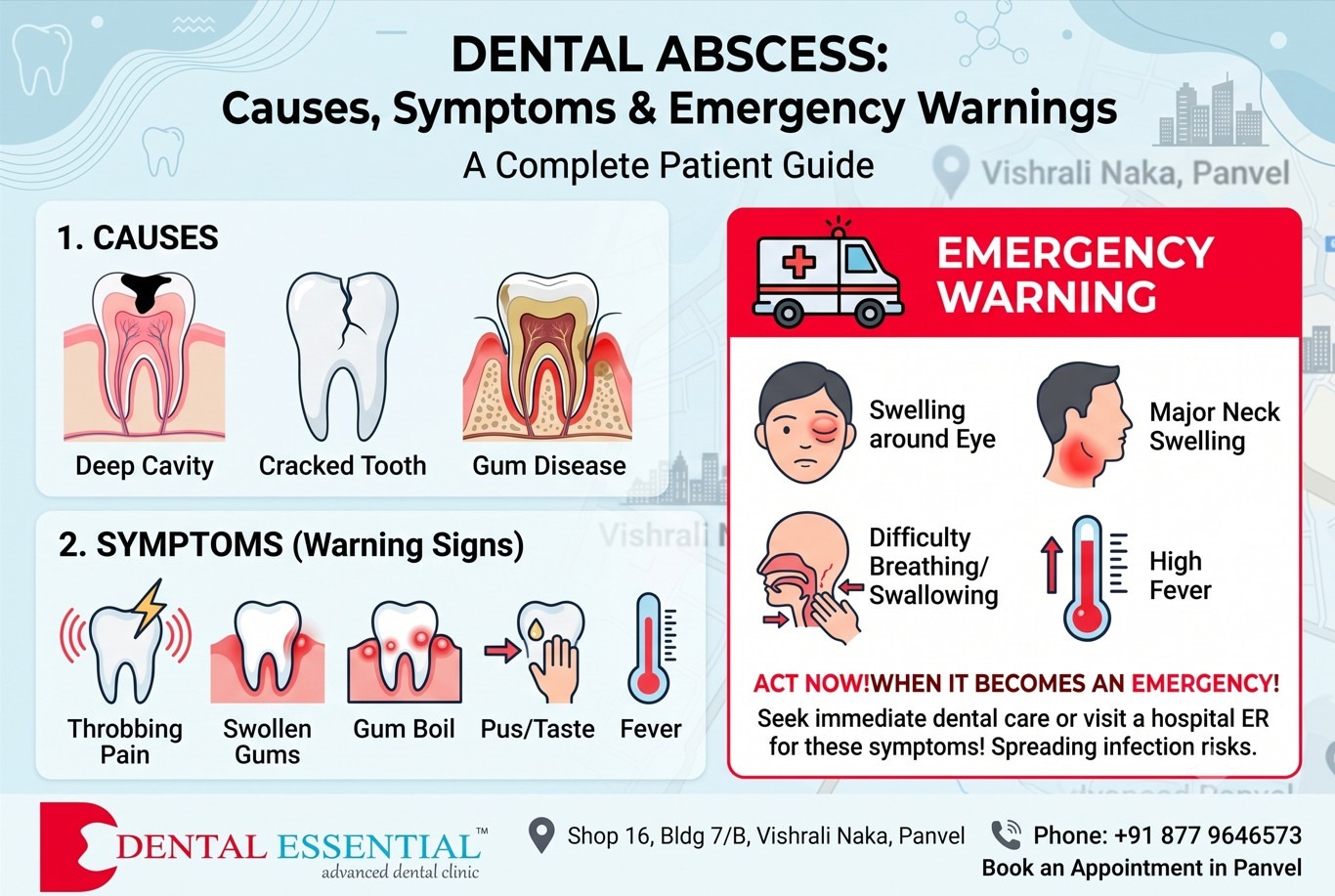
Common signs include:
Clinic lists severe throbbing pain, temperature sensitivity, pain on chewing, fever, facial or neck swelling, swollen lymph nodes and foul-tasting drainage among recognised symptoms of a tooth abscess.
Early Signs of a Dental Abscess You Should Not Ignore
An abscess does not always begin with dramatic facial swelling.
Early symptoms can be easy to dismiss.
✦Persistent Toothache
A toothache that continues, keeps returning or becomes spontaneous may indicate inflammation or infection inside the tooth.
✦Pain When Biting
An infected tooth can become extremely sensitive to pressure.
You may notice that biting even soft foods produces pain.
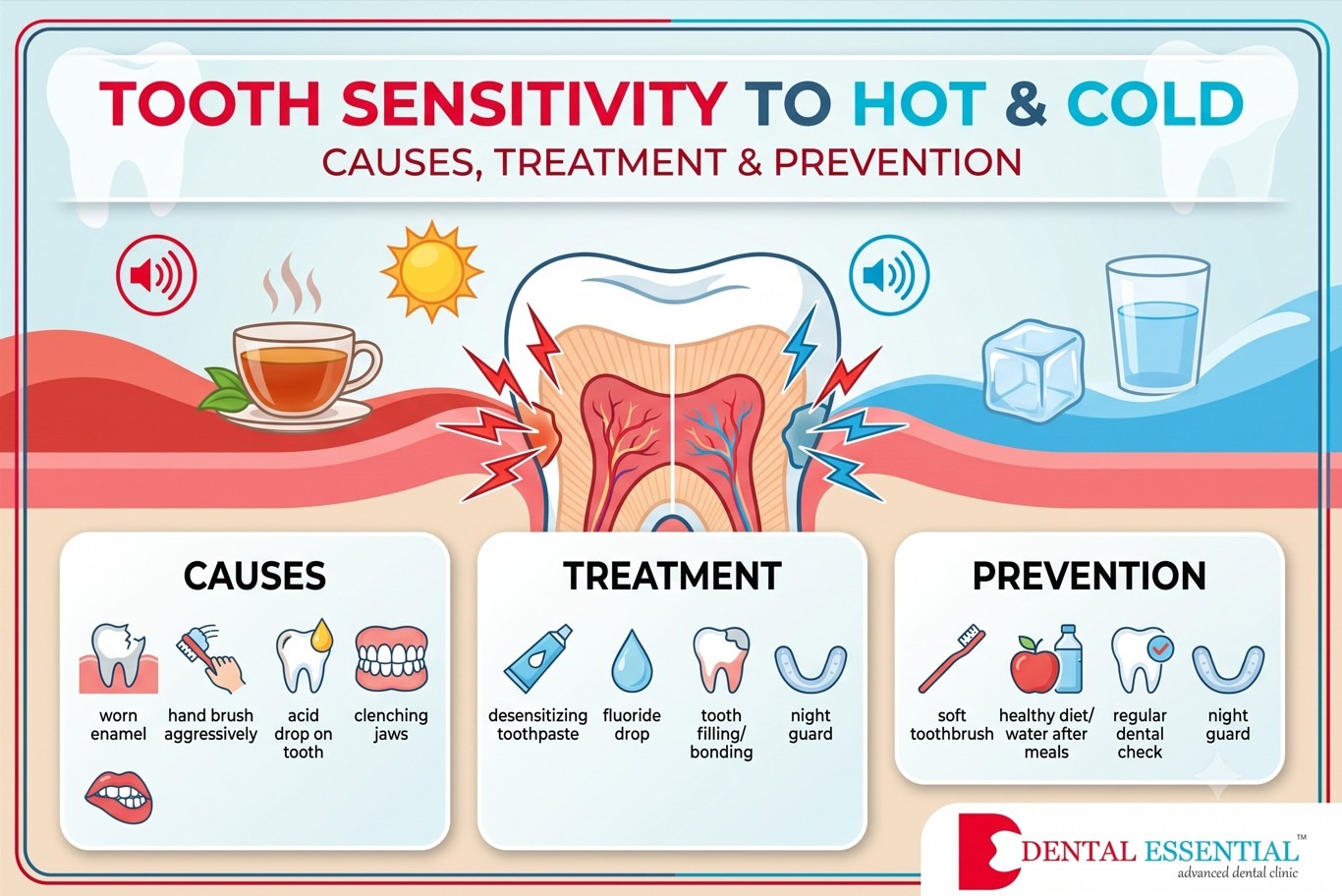
✦Hot and Cold Sensitivity
Temperature sensitivity can occur when decay or infection affects the dental pulp.
✦Gum Swelling Near One Tooth
A small localised swelling beside a tooth should not automatically be dismissed as minor gum irritation.
✦Gum Boil or Pimple
A recurring pimple-like bump on the gum can be a drainage pathway from an underlying infection.
✦Bad Taste
When pus drains into the mouth, patients may notice a suddenly unpleasant, bitter, salty or foul taste.
✦Tooth Discolouration
A tooth that has suffered significant trauma or pulp damage can sometimes become darker.
✦Pain That Wakes You at Night
Severe spontaneous or throbbing nighttime tooth pain may indicate advanced pulp inflammation or infection.
What Does an Abscess Look Like on the Gum?
Some abscesses appear as a:
Patients sometimes call this a gum boil.
The clinical term for a drainage pathway can be a sinus tract.
A gum boil may occasionally be almost painless.
That does not make it harmless.
If the infection has found a route through which pus can drain, the pressure may decrease enough that the tooth feels better while the bacterial source remains present.
Why Did My Abscess Burst and the Pain Suddenly Stop?
This is one of the most important questions in this entire article.
Imagine this sequence:
Day 1: severe throbbing pain.
Day 2: gum swelling develops.
Day 3: you notice an unpleasant salty taste.
Then suddenly:
the pain becomes much better.
It may feel as though the infection has healed.
But the abscess may simply have ruptured and drained.
Clinic notes that an abscess can rupture and release foul-tasting fluid, sometimes producing sudden pain relief. That does not remove the underlying cause of infection.
Clinic similarly warns that pain can disappear even if the infection remains—for example, if infected pulp tissue loses vitality.
Therefore:
Do not cancel your dental appointment simply because an abscess drained or the pain disappeared.
The infection still needs professional evaluation.
What Causes a Dental Abscess?
Dental abscesses develop when bacteria gain access to vulnerable tooth or gum tissues.
Several problems can create that opportunity.
✦Deep Tooth Decay
Untreated dental cavities are one of the major causes of periapical abscesses.
Decay may progress in stages:
enamel decay → dentin decay → pulp inflammation → pulp infection → root infection → abscess
A cavity is therefore much easier to manage before bacteria reach the dental pulp.
This is why early tooth-coloured filling treatment in Panvel may sometimes prevent a small cavity from progressing into a root canal or dental abscess.
✦Cracked or Broken Tooth
A crack creates an opening through which bacteria can reach deeper tooth structures.
Some cracks are obvious.
Others are microscopic and cause symptoms such as:
✦Dental Trauma
A tooth may be damaged after:
The pulp can be injured even when the tooth does not visibly break.
✦Gum Disease
Advanced periodontal disease can create deep pockets around teeth where bacteria accumulate.
This can lead to a periodontal abscess.
Patients experiencing:
should consider professional periodontal evaluation rather than waiting for pain.
✦Impacted or Partially Erupted Tooth
An impacted tooth, including a problematic wisdom tooth, can create areas where bacteria and food become trapped.
The NHS lists impacted teeth among conditions that may contribute to dental abscess formation.
Patients with recurrent back-tooth infection may require evaluation for wisdom tooth removal in Panvel.
✦Previous Dental Problems
A tooth that has:
may become vulnerable to infection.
Who Is More Likely to Develop a Dental Abscess?
Several factors can increase risk.
✦Poor Oral Hygiene
Failure to remove plaque regularly increases the risk of tooth decay and gum disease.
✦Frequent Sugar Exposure
Bacteria use sugars and fermentable carbohydrates to produce acids that contribute to tooth decay.
Clinic identifies high-sugar dietary patterns as one factor that can increase tooth-decay and abscess risk.
✦Dry Mouth
Saliva helps protect teeth and control the oral environment.
Reduced saliva can increase cavity risk.
Dry mouth may occur because of:
✦Smoking
Smoking is associated with poorer periodontal health and Cleveland Clinic lists smoking among factors associated with increased tooth-abscess risk.
✦Weakened Immune System
Certain illnesses and medications can affect the body’s ability to control infections.
People who are immunocompromised should seek professional advice promptly when dental infection is suspected.
How Can You Tell the Difference Between an Abscess and a Normal Toothache?
Not every toothache means you have an abscess.
Tooth pain can result from:
Signs that make infection or abscess more concerning include:
| Symptom / Sign | Clinical Significance | Urgency Level |
|---|---|---|
| Severe constant throbbing pain | Advanced pulp infection or acute periapical inflammation | Urgent Dental Visit |
| Tooth exquisitely painful to bite on | Infection has spread through root apex into jaw ligament | Urgent Dental Visit |
| Gum boil or pimple (parulis / fistula) | Draining abscess channel releasing pus into oral cavity | Schedule Immediate Checkup |
| Visible pus or foul salty discharge | Definitive evidence of active bacterial infection | Urgent Dental Care |
| Swelling of the cheek or jaw | Infection spreading through cortical bone into facial tissues | Same-Day Emergency |
| Fever and swollen lymph nodes | Systemic immune response to spreading bacterial load | Same-Day Emergency |
| Trismus (difficulty opening mouth wide) | Infection spreading into masticatory muscle spaces | Same-Day Emergency |
| Difficulty breathing, swallowing or speaking | Airway compromise (Ludwig's Angina / deep space infection) | 🚨 Immediate Hospital Emergency |
The only reliable way to know is through professional evaluation.
Is a Gum Abscess Different From a Tooth Abscess?
Yes.
A tooth abscess often originates from infection within the dental pulp and root canal system.
A periodontal or gum abscess originates in the tissues supporting the tooth.
The symptoms can overlap.
Both may cause:
Treatment is different, which is why diagnosis matters.
A tooth abscess may require root canal treatment.
A periodontal abscess may require drainage, periodontal cleaning and treatment of the gum pocket.
Do not assume that every swollen gum needs root canal treatment.
How Does a Dentist Diagnose a Dental Abscess?
Diagnosis begins by finding the source of the infection.
✦Clinical Examination
The dentist examines:
✦Tooth Tapping and Pressure Testing
A tooth with inflammation around its root may be particularly sensitive to tapping or pressure.
✦Dental X-Ray
A dental X-ray can help identify:
Dental Essential states that digital X-rays are used when appropriate to identify causes of significant tooth pain and infection.
✦Pulp Testing
Cold, heat or electrical testing may sometimes help determine whether the dental pulp remains healthy or has become irreversibly damaged.
✦Periodontal Examination
If gum disease is suspected, your dentist may check:
✦Advanced Imaging
If infection appears to have spread into the neck or deeper tissues, medical imaging such as CT may sometimes be required.
How Is a Dental Abscess Treated?
The goal is not simply to reduce pain.
The goal is to:
drain infection, eliminate its source and prevent further spread.
Treatment depends on where the infection originated and whether the tooth can still be saved.
✦Incision and Drainage
When there is an accessible collection of pus, the dentist may make a small opening to allow drainage.
Drainage reduces pressure but may not by itself remove the source.
For example, if the source is infected pulp inside the tooth, the tooth still requires definitive treatment.
✦Root Canal Treatment
If infection originates inside the tooth but the tooth remains restorable, root canal treatment may allow it to be preserved.
During root canal therapy, the dentist removes infected or severely damaged pulp tissue, disinfects the root canal system and seals the tooth.
Clinic identifies root canal treatment as one of the principal ways to eliminate infection while saving an abscessed tooth.
Dental Essential provides painless root canal treatment in Panvel, with diagnosis determining whether root canal therapy is appropriate for the affected tooth.
Some suitable cases may potentially be completed using single sitting root canal treatment, whereas others require more than one visit.
Treatment timing depends on:
✦Tooth Extraction
Sometimes a tooth is too severely:
to restore predictably.
In these situations, extraction may be required to remove the source of infection.
Extraction should not automatically be the first solution simply because an abscess exists.
Whenever appropriate, the dentist should assess whether the natural tooth can reasonably be preserved.
✦Periodontal Treatment
For a periodontal abscess, treatment may include:
✦Antibiotics
Antibiotics have an important role in selected dental infections.
But this point deserves very clear explanation.
| Abscess Treatment | When It Is Used | Primary Clinical Objective |
|---|---|---|
| Incision and Drainage (I&D) | Fluctuant, swollen soft tissue collection | Immediately relieves hydrostatic pressure and vents bacterial toxins |
| Painless Root Canal Treatment | Periapical abscess where tooth is restorable | Cleans, sterilizes and seals infected root canals, saving the natural tooth |
| Tooth Extraction | Unrestorable fracture or severe bone loss | Eliminates source of infection when tooth cannot predictably be saved |
| Periodontal Debridement / Deep Scaling | Periodontal gum abscess | Flushes bacteria, debrides infected pockets, and reduces gum inflammation |
| Prescription Adjunctive Antibiotics | Spreading facial cellulitis or systemic fever | Controls systemic spread alongside definitive dental drainage |
Can Antibiotics Alone Cure a Dental Abscess?
Usually, antibiotics alone do not eliminate the physical source of an abscessed tooth.
Clinic notes that antibiotics may help fight bacterial infection but do not remove the source within the affected tooth.
The American Dental Association similarly recommends prioritising definitive dental treatment—such as drainage or root canal procedures—for many localised pulpal and periapical infections rather than routinely relying on antibiotics. Antibiotics become more important when systemic involvement or other clinical factors are present.
Treatment may therefore require:
root canal treatment,
drainage,
extraction,
or another procedure
even if antibiotics are prescribed.
Never:
Why Does an Abscess Sometimes Return After Antibiotics?
Because antibiotics may temporarily reduce bacterial activity or spreading infection without eliminating the underlying source.
Imagine an infected root canal system remains inside a tooth.
Antibiotics may reduce:
But if infected tissue remains inside the tooth, symptoms can return after medication stops.
Definitive dental treatment is therefore essential.
Does Root Canal Treatment Hurt When You Have an Abscess?
Modern root canal treatment is typically performed using local anaesthesia.
The aim is to remove infected tissue and relieve the pressure and inflammation responsible for pain.
Dental Essential currently describes its root-canal care as performed under local anaesthesia with a focus on patient comfort.
Some severely inflamed teeth can require additional anaesthetic management.
Your dentist should evaluate the tooth individually rather than promise that every case will feel identical.
Can a Dental Abscess Go Away on Its Own?
No—not reliably.
This is one of the clearest points in current clinical guidance.
The NHS states that a dental abscess needs urgent dental treatment and does not go away on its own.
Clinic also warns that abscesses do not spontaneously resolve even when pain disappears.
Why does the pain sometimes stop?
Possible reasons include:
None of those possibilities guarantees that the infection has been eliminated.
What Happens If a Dental Abscess Is Left Untreated?
An untreated infection can progress.
Potential consequences include:
✦Increasing Pain
Pressure and inflammation can produce increasingly severe throbbing.
✦Damage to the Tooth
More tooth structure may become compromised.
✦Bone Loss Around the Root
Infection can affect supporting bone.
✦Spread Into Neighbouring Tissues
Infection can move beyond the original tooth.
✦Facial Swelling
The cheek, jaw or surrounding tissues may become swollen.
✦Spread Into the Neck
More extensive infection can involve deeper tissue spaces.
✦Airway Compromise
Severe swelling can interfere with breathing or swallowing.
✦Systemic Infection
Rarely, severe dental infection may contribute to life-threatening complications.
Clinic warns that untreated tooth abscesses can produce serious and potentially life-threatening complications.
The lesson is not that every abscess will become life-threatening.
It is that there is no benefit in testing how far an untreated infection will progress.
When Does a Dental Abscess Become an Emergency?
This is the most important distinction for patients.
✦Contact a Dentist Urgently If You Have
A dental abscess needs professional treatment even when symptoms are still localised.
✦Seek Emergency Medical Care Immediately If You Have
The NHS specifically identifies breathing, swallowing or speaking difficulty, major oral swelling and eye involvement as emergency warning signs.
Clinic likewise advises emergency evaluation when facial swelling is accompanied by fever and dental care is unavailable, or when breathing or swallowing becomes difficult.
Dentist or Hospital: Where Should You Go?
This distinction is worth remembering.
✦Usually Start With an Urgent Dentist
For:
A dentist can diagnose and treat the source.
✦Go to a Hospital Emergency Department for Serious Spreading Infection
For:
The hospital can manage threats extending beyond routine dental treatment.
After the immediate medical emergency is stabilised, the infected tooth may still need definitive dental treatment.
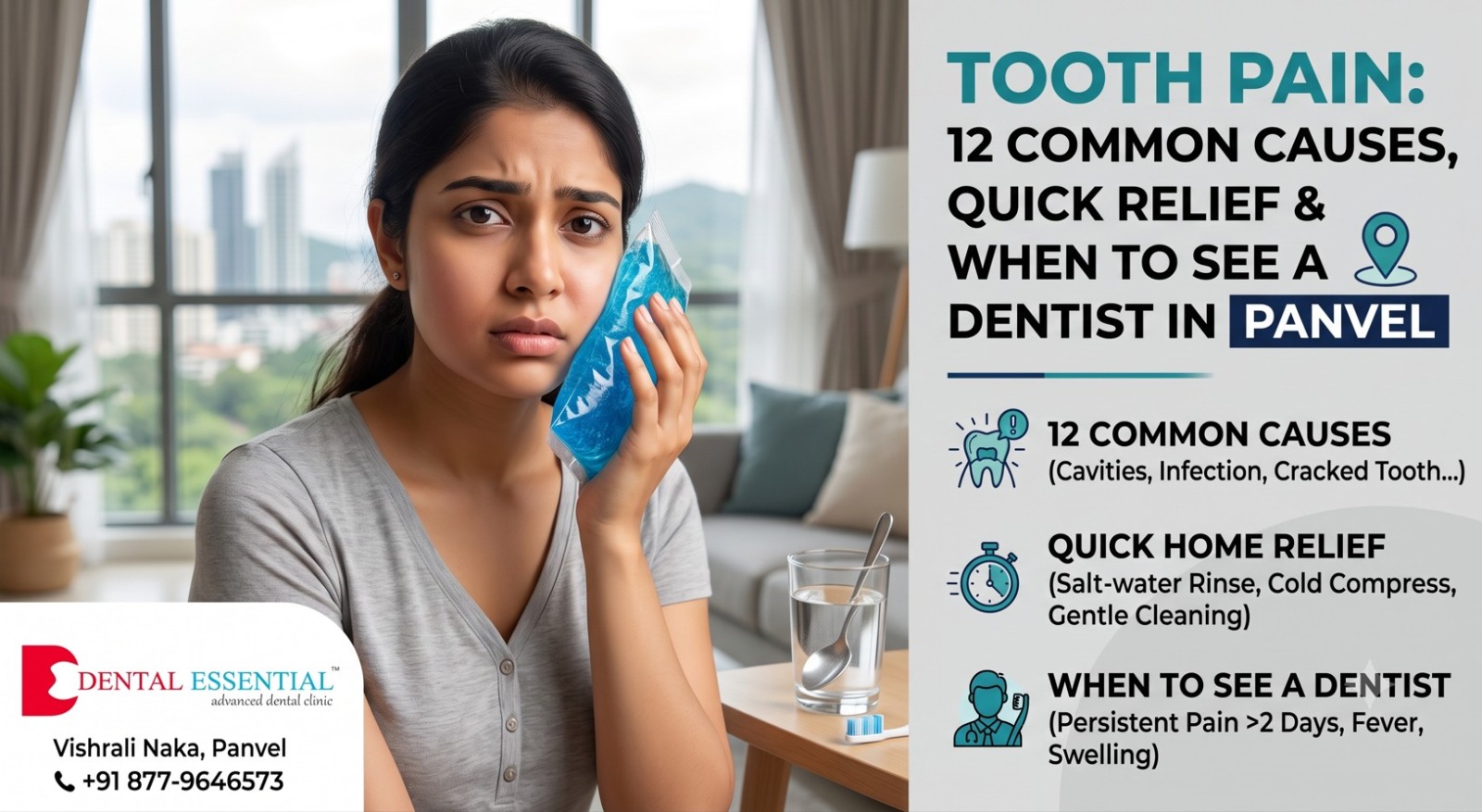
What Can You Do for Dental Abscess Pain Until You See a Dentist?
You cannot cure an abscess at home.
However, a few measures may temporarily make you more comfortable while arranging care.
✦Take Appropriate Pain Relief
Medicines such as ibuprofen or paracetamol may help some patients when taken according to directions and when medically safe.
Do not exceed the recommended dose.
People with:
should obtain appropriate professional advice.
✦Rinse Gently With Warm Salt Water
Salt-water rinsing can temporarily soothe irritated tissues and help keep the mouth clean.
It will not eliminate an abscess.
✦Eat Soft Foods
Choose foods that require less chewing.
Chew on the opposite side when possible.
✦Avoid Temperature Extremes
Very hot or cold foods may trigger additional pain.
✦Use a Soft Toothbrush
Continue gentle oral hygiene around the area.
Do not stop cleaning your mouth completely because a tooth hurts.
✦Cold Compress for Facial Swelling
A wrapped cold pack applied externally may help temporarily with discomfort.
What Should You NOT Do With a Dental Abscess?
✦Do Not Try to Pop It
Do not pierce or squeeze a dental abscess with:
You cannot safely treat the underlying infection this way.
✦Do Not Put Aspirin Directly on the Gum
This can irritate or chemically damage oral tissue.
✦Do Not Take Random Antibiotics
Never use leftover medication simply because the swelling resembles a previous infection.
✦Do Not Assume Drainage Means Cure
Reduced pain after pus drains is not proof that the infection has resolved.
✦Do Not Delay Because Tomorrow Is More Convenient
Dental infection does not follow work schedules, weekends or travel plans.
If symptoms suggest an abscess, seek timely dental evaluation.
Dental Abscess vs Tooth Sensitivity
These conditions can overlap, but they are not the same.
✦Typical Dentin Sensitivity
Often produces:
✦Possible Abscess or Advanced Infection
May produce:
If what began as tooth sensitivity to hot and cold progresses to persistent or spontaneous pain, do not continue treating it only with sensitivity toothpaste.
Dental Abscess vs Toothache at Night
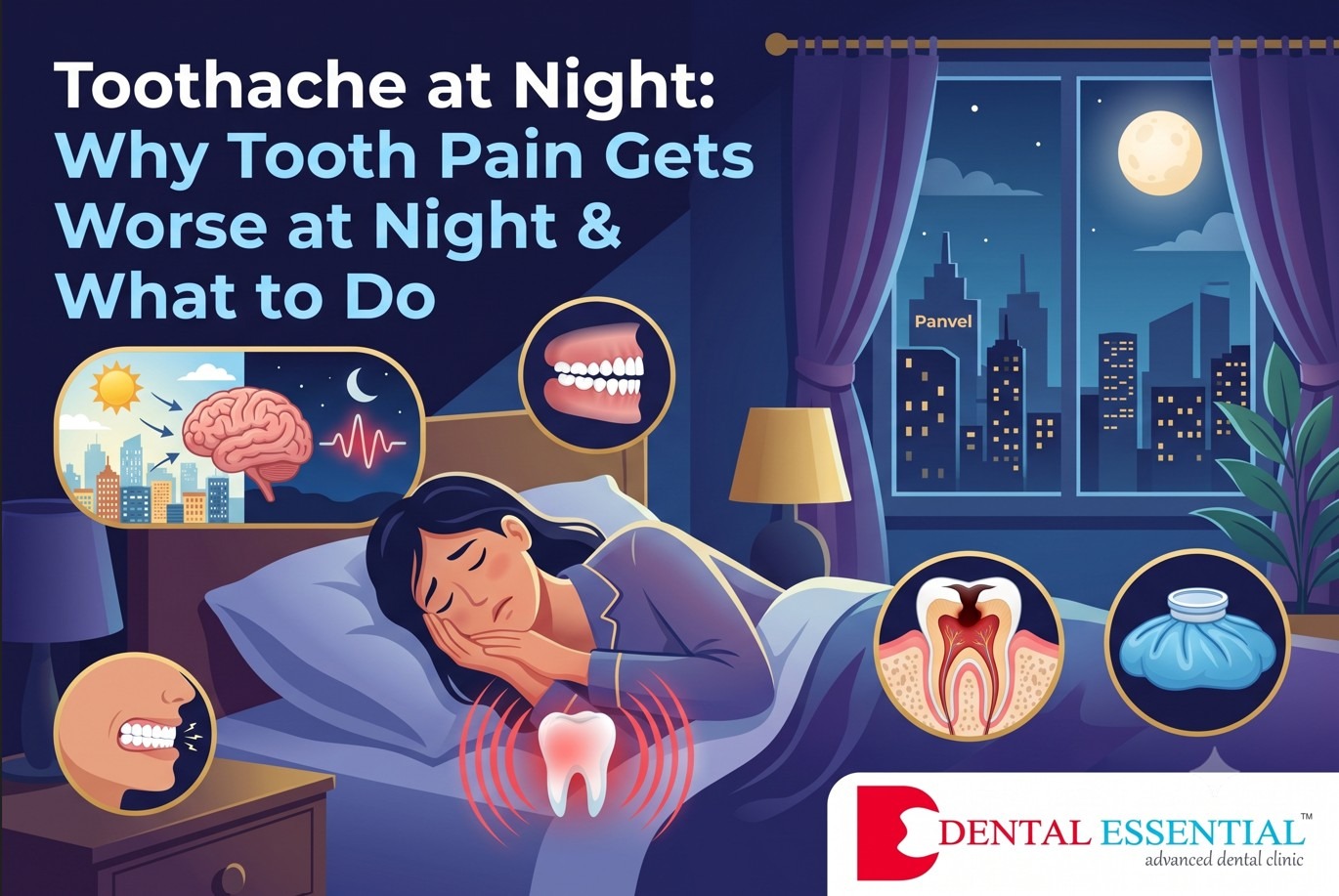
Nighttime pain by itself does not prove that an abscess is present.
However, infection can cause severe throbbing pain that disrupts sleep.
If nighttime toothache is accompanied by:
abscess becomes more concerning.
Dental Abscess and Wisdom Teeth
Partially erupted or impacted wisdom teeth can create areas that trap bacteria and food debris.
Symptoms may include:
An examination and dental X-ray can help determine whether cleaning, medication, drainage or wisdom tooth removal in Panvel is appropriate.
Dental Abscess in Children
Children can also develop dental abscesses.
Common causes include:
Parents should seek prompt dental assessment if a child develops:
Do not dismiss an infected baby tooth because it will eventually fall out.
Primary teeth remain important for:
Dental Essential provides kids dental care and pediatric dentistry in Panvel for children requiring dental assessment and treatment.
Can a Dental Abscess Develop Under a Crown?
Yes.
A crowned tooth can still develop infection if:
A dental X-ray and clinical examination can help identify the cause.
Can You Have a Dental Abscess Without Pain?
Yes.
Pain is common, but it is not mandatory.
A chronic infection may drain through a gum opening and create relatively little pressure.
You might notice only:
This is precisely why a painless gum boil should still be checked.
Can an Abscess Form After Root Canal Treatment?
It is possible for a previously treated tooth to develop recurrent infection.
Potential reasons include:
The tooth should be assessed rather than assuming that extraction is automatically required.
Depending on the situation, options may include:
How Soon Will You Feel Better After Dental Abscess Treatment?
Many patients begin to feel substantially better after pressure is relieved and the infection source is treated.
However, recovery varies.
Some tenderness or sensitivity can remain for a few days.
Clinic notes that temporary sensitivity after treatment is common and recovery time varies between cases.
Follow your dentist’s instructions carefully and return if:
How Can You Prevent a Dental Abscess?
Most prevention strategies are straightforward.
✦Brush Twice Daily With Fluoride Toothpaste
Effective brushing reduces plaque and lowers cavity risk.
✦Clean Between Teeth Every Day
Floss or interdental brushes help remove plaque where toothbrush bristles cannot effectively reach.
✦Reduce Frequent Sugar Exposure
The frequency of sugar consumption matters.
Repeated sipping and snacking gives oral bacteria repeated opportunities to produce acids.
✦Attend Dental Check-Ups
Routine dental check-ups may identify cavities, defective restorations and gum disease before infection develops.
✦Treat Cavities Early
A small filling is far simpler than treating an infected dental pulp.
✦Do Not Ignore Cracked Teeth
Pain on biting or sudden sensitivity deserves assessment.
✦Treat Gum Disease
Bleeding and swollen gums should not become normal.
Early bleeding gum treatment in Panvel may help prevent periodontal problems from progressing.
✦Protect Teeth From Trauma
Use an appropriate mouthguard during contact sports and other high-risk activities.
✦Address Dry Mouth
Ask a dentist or healthcare professional about persistent dry mouth, especially when medication-related.
Dental Infection and Everyday Life in Panvel
A dental abscess is caused by infection—not someone’s religion, caste, community, political beliefs or economic background.
Those characteristics should never be treated as biological causes of dental disease.
What can matter are practical daily behaviours and access to care.
Panvel is home to students, families, professionals, business owners and commuters travelling throughout Navi Mumbai and the wider Mumbai Metropolitan Region.
A common real-world pattern is:
“The tooth hurts, but I have work tomorrow.”
Then:
“It feels slightly better, so I’ll wait until the weekend.”
Then:
“The gum is swollen, but I can still manage.”
This is exactly the behaviour that can allow an easily treatable dental problem to progress.
Dental infections do not become safer because pain medication makes them temporarily tolerable.
✦Food Habits and Tooth-Decay Risk
Sweetened chai, biscuits, desserts, soft drinks and repeated snacks can increase the frequency of sugar exposure.
During:
sweets naturally form part of celebrations in many households.
The recommendation is not to avoid cultural celebrations.
A more realistic dental strategy is to:
Practical prevention works better than unrealistic restrictions.
Searching “Dentist Near Me” for a Dental Abscess?
When severe pain or swelling appears, patients commonly search:
dentist near me
dental clinic near me
dentist open now
dental clinic open now
emergency dentist near me
emergency dental care in Panvel
best dentist in Panvel for tooth infection
Location is important during an urgent dental problem.
But do not choose solely based on proximity.
Look for a dental clinic that can:
The goal is not simply to give temporary pain relief.
It is to remove or control the source of infection.
Dental Abscess Treatment at Dental Essential, Panvel
Dental Essential – Advanced Dental Clinic provides dental assessment and treatment at Vishrali Naka, Panvel.
The clinic currently provides treatment options including:
Patients experiencing:
can be examined to determine whether treatment requires:
Dental Essential also states that it provides emergency dental care for severe toothaches and dental infections.
About Dr. Sameer R. Gharat
Dental Essential is led by Dr. Sameer Ramchandra Gharat, Chief Dentist, Prosthodontist and Implantologist.
Dental Essential lists his qualifications as:
BDS, MDS – Prosthodontics & Implantology
and he has 16+ years of clinical experience.
Dental Essential – Advanced Dental Clinic in Panvel
Address:Shop 16, Bldg 7/B, Gurusharnam ComplexVishrali Naka, Panvel – 410206
Phone:+91 877-9646573
Clinic Hours:Monday–Saturday: 10:00 AM–2:00 PMMonday–Saturday: 5:00 PM–9:00 PMSunday: Closed
Areas Served
Dental Essential serves patients from:
Final Takeaway
A dental abscess should never be treated as “just another toothache.”
It is an infection that requires professional assessment and definitive treatment.
Watch for warning signs such as:
Remember three key rules.
First: an abscess does not reliably go away by itself.
Second: antibiotics may be useful in selected cases but often do not remove the source of infection.
Third: breathing or swallowing difficulty, major facial or neck swelling and other signs of spreading infection require emergency medical care.
Early treatment may allow a dentist to:
drain the infection,
save the natural tooth with root canal treatment,
treat the gum infection,
or otherwise manage the problem before it becomes more serious.
If you have symptoms of a dental abscess, tooth infection or severe toothache in Panvel,
Contact: Dental Essential – Advanced Dental Clinic
Address:📍 Shop 16, Bldg 7/B, Gurusharnam Complex, Vishrali Naka, Panvel – 410206
📞 +91 877-9646573
Monday–Saturday:10:00 AM–2:00 PM5:00 PM–9:00 PM
Sunday: Closed
For severe mouth, face or neck swelling affecting breathing or swallowing, seek emergency medical care rather than waiting for normal clinic hours.
Frequently Asked Questions About Dental Abscesses
✦1. What is the first sign of a dental abscess?
Early symptoms may include persistent toothache, pain while biting, temperature sensitivity or local gum swelling.
Some people first notice a small pimple or boil on the gum.
✦2. What does dental abscess pain feel like?
It is often described as:
However, some chronic abscesses cause surprisingly little pain.
✦3. Can a dental abscess go away on its own?
No.
The infection requires dental assessment and treatment.
Pain may temporarily decrease if the abscess drains or the nerve loses vitality, but this does not prove the infection has resolved.
✦4. Can an abscess heal after it pops?
Not necessarily.
Drainage reduces pressure and may dramatically reduce pain.
The underlying infected tooth or periodontal problem still needs treatment.
✦5. Can antibiotics cure a tooth abscess?
Antibiotics may be necessary for selected infections, particularly when there is spreading or systemic involvement.
However, antibiotics do not automatically eliminate the source inside an infected tooth.
Drainage, root canal treatment or extraction may still be needed.
✦6. How quickly can a tooth abscess spread?
There is no predictable timetable.
Spread may occur over different periods in different patients, so there is no reliably safe number of days to leave an abscess untreated.
✦7. Does every dental abscess need a root canal?
No.
Treatment depends on the source.
A restorable tooth with infected pulp may need root canal treatment.
A periodontal abscess may require gum treatment.
A tooth that cannot be restored may require extraction.
✦8. Can a tooth abscess cause facial swelling?
Yes.
Infection can spread from the tooth into surrounding facial tissues.
Facial swelling should be assessed promptly.
✦9. Can a dental abscess cause fever?
Yes.
Fever may occur when the body is responding to infection and can be a warning sign of more extensive disease.
✦10. Is a dental abscess always painful?
No.
Some chronic infections drain through the gum and cause little pain.
A painless gum boil can still indicate infection.
✦11. What does pus from a tooth abscess taste like?
Patients often describe an unpleasant, salty, bitter or foul taste when an abscess drains.
✦12. Can I pop a gum abscess myself?
No.
Do not attempt to puncture or squeeze an abscess.
Professional treatment is required to identify and eliminate the source of infection.
✦13. Should I use a hot compress on a dental abscess?
For facial dental swelling, avoid experimenting with intense heat.
A wrapped cold compress externally may temporarily reduce discomfort while you arrange professional care.
✦14. Can I brush around an abscess?
Yes, continue gentle oral hygiene.
Use a soft toothbrush and avoid aggressive pressure on the swollen area.
✦15. Can a dental abscess cause bad breath?
Yes.
Bacterial infection and draining pus can create unpleasant breath or taste.
✦16. Can a cavity become an abscess?
Yes.
Untreated decay can progress through enamel and dentin into the dental pulp, eventually causing infection and a periapical abscess.
✦17. Can gum disease cause an abscess?
Yes.
Advanced periodontal disease can produce a periodontal abscess in the tissues supporting a tooth.
✦18. Can wisdom teeth cause an abscess?
Impacted or partially erupted teeth may contribute to infection around the back of the mouth.
A dental examination determines whether cleaning, treatment or wisdom tooth extraction is required.
✦19. Is a dental abscess contagious?
The abscess itself is not typically described as a contagious condition passed from one person to another.
However, oral bacteria can be exchanged through saliva. Good oral hygiene and appropriate dental treatment remain important.
✦20. Can a dental abscess return?
Yes.
It may recur if the underlying source is not eliminated.
Recurrent swelling requires reassessment.
✦21. Can I go to sleep with a dental abscess?
If symptoms are localised and you are awaiting urgent dental treatment, temporary pain-management measures may help.
However, do not simply go to sleep and wait if swelling is rapidly increasing or you develop difficulty breathing, swallowing or speaking.
Those symptoms require emergency medical attention.
✦22. When should I go to the hospital for a tooth abscess?
Seek emergency medical care for:
✦23. How is a dental abscess diagnosed?
Your dentist may perform:
Advanced imaging may be required if infection has spread more deeply.
✦24. How is an abscessed tooth treated?
Treatment may include:
The correct treatment depends on the source and extent of infection.
✦25. Can an abscessed tooth be saved?
Often, yes—if enough healthy tooth structure remains and the infection can be treated predictably.
Root canal treatment may preserve a tooth that would otherwise require extraction.
✦26. Is root canal treatment better than extraction for an abscess?
Neither option is automatically “better.”
When a tooth can be predictably saved, preserving the natural tooth may be desirable.
When it is severely fractured or structurally hopeless, extraction may be more appropriate.
A dentist should assess the tooth before recommending either option.
✦27. Is a dental abscess dangerous during pregnancy?
Dental infection should not be ignored during pregnancy.
Tell your dentist that you are pregnant so diagnostic and treatment decisions can be planned appropriately.
Seek prompt professional care rather than self-medicating.
✦28. Can children develop dental abscesses?
Yes.
Untreated cavities and trauma can lead to abscesses in primary or permanent teeth.
Facial swelling, fever or significant dental pain in a child requires prompt professional assessment.
✦29. Where can I get dental abscess treatment in Panvel?
Dental Essential provides dental assessment at:
Shop 16, Bldg 7/B, Gurusharnam Complex, Vishrali Naka, Panvel – 410206.
Depending on diagnosis, treatment may involve root canal therapy, drainage, periodontal treatment, extraction or another appropriate procedure.
✦30. What should I do if I have tooth pain and swelling tonight?
If symptoms are localised, arrange urgent dental care and use only appropriate temporary pain-relief measures.
If swelling is affecting breathing, swallowing or speaking, or is rapidly spreading through the face or neck, seek emergency medical attention immediately.
Ready for a Healthier, Straighter Smile?
Consult with expert dentists at Dental Essential Clinic in Panvel. Get personalized treatment plans & affordable care.
Share this article