



Understanding Nighttime Toothache: Why Night Makes Tooth Pain Worse
You manage your day with only a mild ache.
Then you go to bed.
Within minutes, that dull discomfort turns into a throbbing toothache that seems impossible to ignore. You change sides, try another pillow and wonder:
“Why does my tooth hurt so much more at night?”
If this sounds familiar, you are not imagining the discomfort.
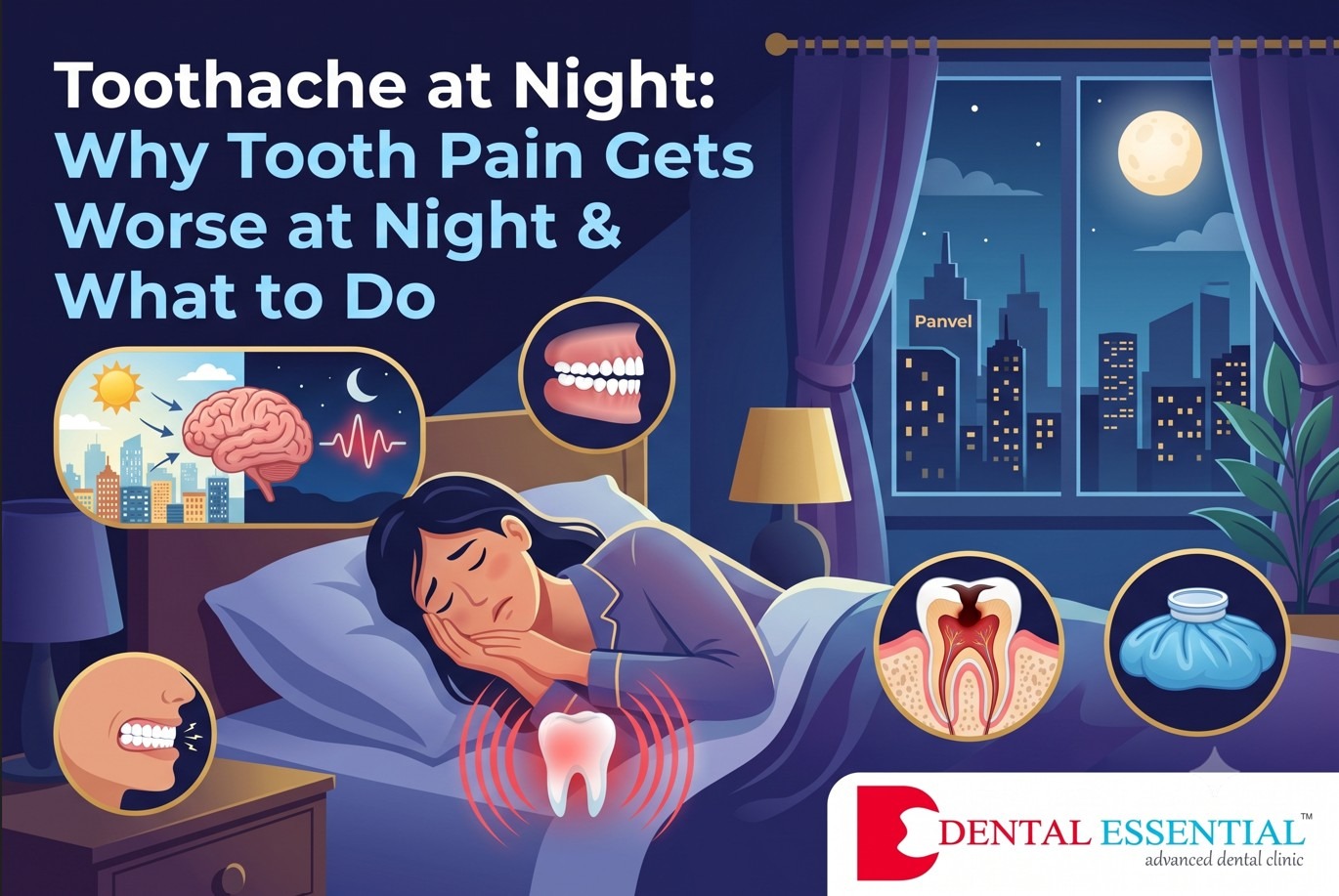
A toothache may become more noticeable at night because lying flat can make throbbing around inflamed dental tissues feel more intense, there are fewer distractions competing for your attention, and conditions such as teeth grinding, deep cavities, dental infection or tooth sensitivity may become particularly noticeable while you are trying to sleep.
But there is something more important to understand:
A tooth that repeatedly keeps you awake may be affected by tooth decay, inflammation of the dental pulp, a dental abscess, a cracked tooth, gum disease, an impacted wisdom tooth or another condition that deserves proper diagnosis.
Quick Answer: Why Does Tooth Pain Get Worse at Night?
Toothache may feel worse at night for several reasons:
Temporary measures such as keeping your head slightly elevated, using a cold compress externally, rinsing with warm salt water and taking an appropriate over-the-counter pain reliever if it is safe for you may reduce discomfort.
However, these measures do not cure a cavity, cracked tooth or dental infection.
If the pain is severe, recurring or keeps waking you from sleep, arrange a dental examination.
Is It Normal for a Toothache to Hurt More at Night?
It is a common experience—but that does not mean the underlying cause should be considered normal.
Many dental articles focus almost entirely on the fact that lying down can make pain more noticeable. That explains part of the nighttime experience, but it does not explain why the tooth is painful in the first place.
The important question is therefore not simply:
“Why does my tooth hurt more at night?”
It is:
“What is causing my tooth to hurt?”
The NHS lists common causes of toothache including:
Persistent toothache should therefore be evaluated based on its underlying cause rather than repeatedly suppressed with pain medication.
Why Does Tooth Pain Become Worse When You Lie Down?
✦1. Your Sleeping Position Can Make Throbbing More Noticeable
When you lie flat, changes in blood flow and pressure around your head and inflamed dental tissues can make an already painful tooth feel more noticeable.
This is why some people experience a relatively manageable ache while sitting or standing but develop stronger throbbing tooth pain when lying down.
Sleeping with your head slightly elevated may make the throbbing less noticeable for some people.
However, elevation is only a temporary comfort measure.
It does not remove decay, treat an infected pulp or cure a dental abscess.
✦2. Your Brain Has Fewer Distractions at Night
During the daytime, your attention is divided between:
work
travel
family
conversations
phone calls
meals
traffic
screens
and hundreds of other sensory inputs
A mild toothache has to compete with all of them.
At night, the room becomes quiet.
You stop moving.
There is much less competing sensory information.
Now the aching tooth becomes the centre of your attention.
This does not necessarily mean the tooth suddenly became dramatically worse at 11 PM.
Sometimes you are simply more aware of the pain.
But pain severe enough to repeatedly interrupt sleep still deserves investigation.
✦3. You May Be Grinding or Clenching Your Teeth While Sleeping
Bruxism means grinding, clenching or gnashing the teeth.
It can occur while awake or asleep.
Many people with sleep bruxism have no idea that they grind their teeth until they begin experiencing symptoms such as:
Sleep bruxism can place additional force on a tooth that is already weakened by a cavity, large filling or small crack.
That can explain why somebody experiences tooth pain mainly at night or wakes with sore teeth and jaw muscles in the morning.
A dentist can examine the teeth for wear, cracks and bite-related problems and determine whether a protective night guard or another treatment may be appropriate.
✦4. Evening Food and Drinks May Trigger an Already Sensitive Tooth
Dental pain may appear after eating or drinking:
The issue is usually not simply that you ate at night.
The trigger often reveals an underlying problem such as:
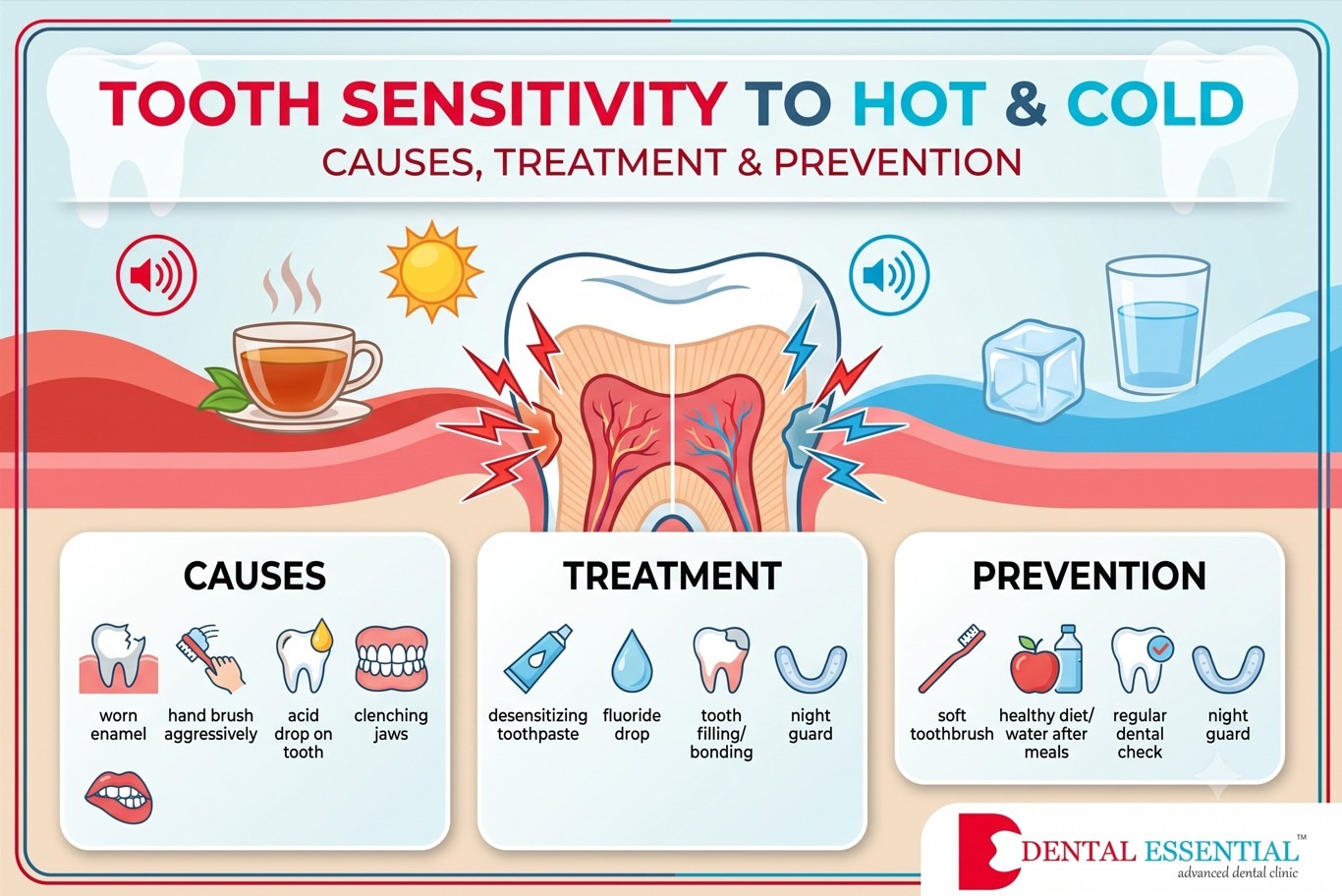
If drinking cold water creates a brief sharp sensation that disappears immediately, sensitivity is one possibility.
If the pain lingers well after the cold or hot drink has gone, inflammation inside the tooth may be more significant.
✦5. Pain Medication May Be Wearing Off
Someone who has managed a painful tooth throughout the day with an over-the-counter pain reliever may notice the pain returning as the effect wears off.
That can create the impression that the tooth is somehow “activated” at night.
Medication can temporarily decrease pain.
It does not necessarily treat the dental disease responsible for that pain.
This distinction becomes especially important when pain repeatedly returns as soon as medication wears off.
What Does Your Nighttime Tooth Pain Pattern Mean?
The exact pattern cannot diagnose the condition by itself, but it can provide useful clues.
| Nighttime Tooth Pain Pattern | What It Usually Indicates | Recommended Action |
|---|---|---|
| Deep throbbing toothache that wakes you up | Acute dental pulp inflammation or apical infection | Urgent dental evaluation; likely needs [root canal treatment](/services/painless-root-canal) |
| Spontaneous throbbing without any trigger | Deep decay, advanced pulpitis or developing abscess | Clinical exam & digital X-ray before infection spreads |
| Sharp pain upon biting down or chewing | Cracked tooth, leaking restoration or root inflammation | Avoid chewing on that side; see dentist to prevent tooth split |
| Lingering sensitivity after hot/cold drinks | Irreversible nerve inflammation inside the pulp | Painless root canal treatment |
| Brief sensitivity (< 2–3 sec) to cold | Exposed root dentin, gum recession or early cavity | Desensitizing toothpaste & routine dental checkup |
| Morning jaw soreness, tightness & headache | Sleep bruxism (nocturnal teeth grinding/clenching) | Custom protective dental night guard |
| Pain behind the last back molar | Partially erupted or impacted wisdom tooth (pericoronitis) | Evaluation for [wisdom tooth extraction](/services/wisdom-tooth-extraction) |
| Swollen gum with foul/salty discharge | Dental abscess with drainage from infected root | Urgent in-clinic drainage & definitive treatment |
| Upper back teeth aching with sinus congestion | Maxillary sinus pressure mimicking dental pain | Rule out dental infection first with intraoral testing |
| Pain centered around an older filling or crown | Marginal microleakage or secondary recurrent decay | Restoration repair or replacement dental crown |
A dental examination and dental X-ray when clinically appropriate are more reliable than trying to diagnose the cause based on symptoms alone.
8 Common Causes of Toothache at Night
✦1. Deep Tooth Decay or Dental Cavity
Tooth decay begins when bacteria interact with sugars and starches from food and drinks and produce acids that damage tooth enamel.
Early decay often causes no symptoms.
As decay travels deeper into the tooth, you may develop:
When decay reaches the deeper dentin and approaches the nerve-containing pulp, symptoms may become much stronger.
Untreated decay can eventually cause pain, infection and tooth loss.
✦Treatment
Depending on depth, treatment may involve:
tooth-coloured filling treatment,a dental crown,or root canal treatment if the pulp has become irreversibly inflamed or infected.
For patients searching for tooth coloured filling treatment in Panvel, an examination helps determine whether a filling is still sufficient or whether the decay has progressed further.
✦2. Pulpitis — Inflammation of the Tooth Nerve
The centre of the tooth contains dental pulp with nerves and blood vessels.
Deep cavities, cracks, trauma or repeated dental procedures can irritate the pulp.
Early pulp inflammation can sometimes produce temporary sensitivity.
More advanced inflammation can cause:
People sometimes describe this as:
“tooth nerve pain at night.”
If the pulp cannot recover, root canal treatment may be required to remove infected or irreversibly inflamed tissue and preserve the tooth.
✦3. Dental Abscess or Tooth Infection
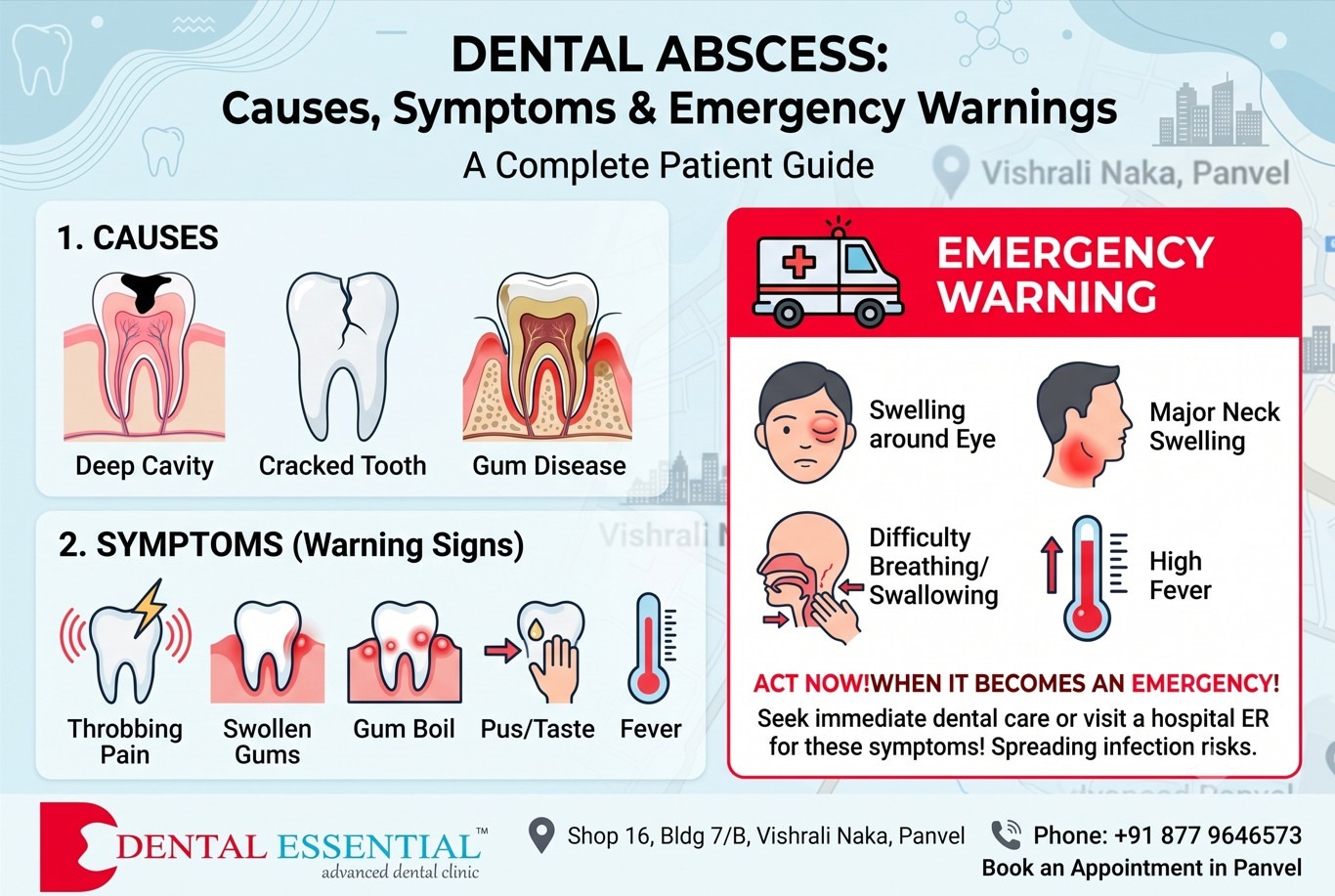
A dental abscess is a pocket of pus resulting from bacterial infection.
It may develop after bacteria enter the dental pulp through:
Possible symptoms include:
A dental abscess can become serious if infection spreads beyond the tooth.
Facial or neck swelling with difficulty breathing or swallowing is an emergency and requires immediate medical attention.
✦Important: Can antibiotics cure a tooth abscess?
Antibiotics may be required in certain infections, particularly where there are systemic signs or spreading infection.
But antibiotics alone do not necessarily eliminate the infected source inside a tooth.
Treatment may require:
depending on the condition of the tooth.
Do not self-medicate with leftover antibiotics.
✦4. Cracked or Fractured Tooth
A tiny crack can produce surprisingly intense pain.
Teeth can crack because of:
Cracked-tooth pain can be unusual.
A person may experience a sudden sharp pain while biting and then feel fine seconds later.
Some cracks are difficult to see, which is why the tooth may appear completely normal when you look in the mirror.
Treatment could involve:
depending on the location and depth of the crack.
✦5. Broken or Leaking Filling or Crown
If an existing dental filling cracks, loosens or becomes worn, bacteria and temperature changes may reach previously protected tooth structure.
Similarly, a damaged crown can expose the underlying tooth.
Symptoms may include:
A dentist may use clinical testing and X-rays to determine whether the restoration simply needs replacement or whether deeper treatment is required.
✦6. Impacted or Infected Wisdom Tooth
Pain at the back of the mouth—especially behind the last molar—may involve a wisdom tooth.
Partially erupted or impacted wisdom teeth can create areas where food and bacteria become trapped.
Symptoms can include:
Not every wisdom tooth requires removal.
A dental examination and X-ray can determine whether monitoring, local treatment or wisdom tooth removal in Panvel is appropriate.
✦7. Gum Disease
Sometimes what feels like tooth pain actually comes from the tissues surrounding the teeth.
Signs of gum problems may include:
If nighttime tooth discomfort occurs together with bleeding or swollen gums, professional evaluation may reveal that gum treatment rather than root canal treatment is necessary.
Dental Essential also evaluates patients looking for bleeding gum treatment in Panvel.
✦8. Sinus Pressure
Not every toothache is actually caused by a tooth.
The roots of the upper back teeth sit close to the maxillary sinus.
Sinus congestion or inflammation can sometimes create pain that feels as though it originates from several upper teeth.
Signs that sinus pressure might be involved include:
A dentist can help rule out dental causes.
If the teeth appear healthy, medical evaluation may sometimes be required.
Toothache Only at Night but Fine During the Day — Should You Worry?
Yes, if it repeatedly happens.
Pain being absent during the day does not prove that your tooth is healthy.
You may simply notice the problem less because you are upright and distracted.
Alternatively, sleep bruxism could be contributing to symptoms primarily at night.
More importantly, early dental disease often produces intermittent symptoms.
A cavity does not need to hurt continuously.
A cracked tooth can hurt only when pressure is applied.
Pulp inflammation may initially come and go.
So the fact that your tooth “feels fine again in the morning” is not a reliable reason to postpone assessment after repeated nighttime attacks.
Why Did My Severe Toothache Suddenly Stop?
This question deserves special attention.
People sometimes experience intense dental pain for several days and then suddenly feel much better.
They naturally assume:
“The infection has healed.”
That is not always what happened.
If inflammation or infection severely damages the pulp, the nerve tissue inside the tooth can lose vitality.
Pain may temporarily decrease even though infection remains around the root.
Likewise, an abscess that drains may produce temporary relief while the underlying infection remains.
Therefore:
If you recently had severe spontaneous or nighttime pain, arrange a dental examination even if symptoms have improved.
How to Relieve Toothache at Night Until You Can See a Dentist
These measures are intended for temporary comfort, not permanent treatment.
✦1. Keep Your Head Slightly Elevated
Use an extra pillow or raise your head slightly.
For some people, lying completely flat makes throbbing dental pain more noticeable.
Elevation may help you rest until dental care is available.
✦2. Rinse With Warm Salt Water
A simple salt-water rinse can help clean the mouth and soothe irritated tissues.
Mix approximately half a teaspoon of salt into a glass of warm water.
Gently rinse and spit it out.
Do not swallow the rinse.
Young children should not use salt-water rinses if they may swallow them.
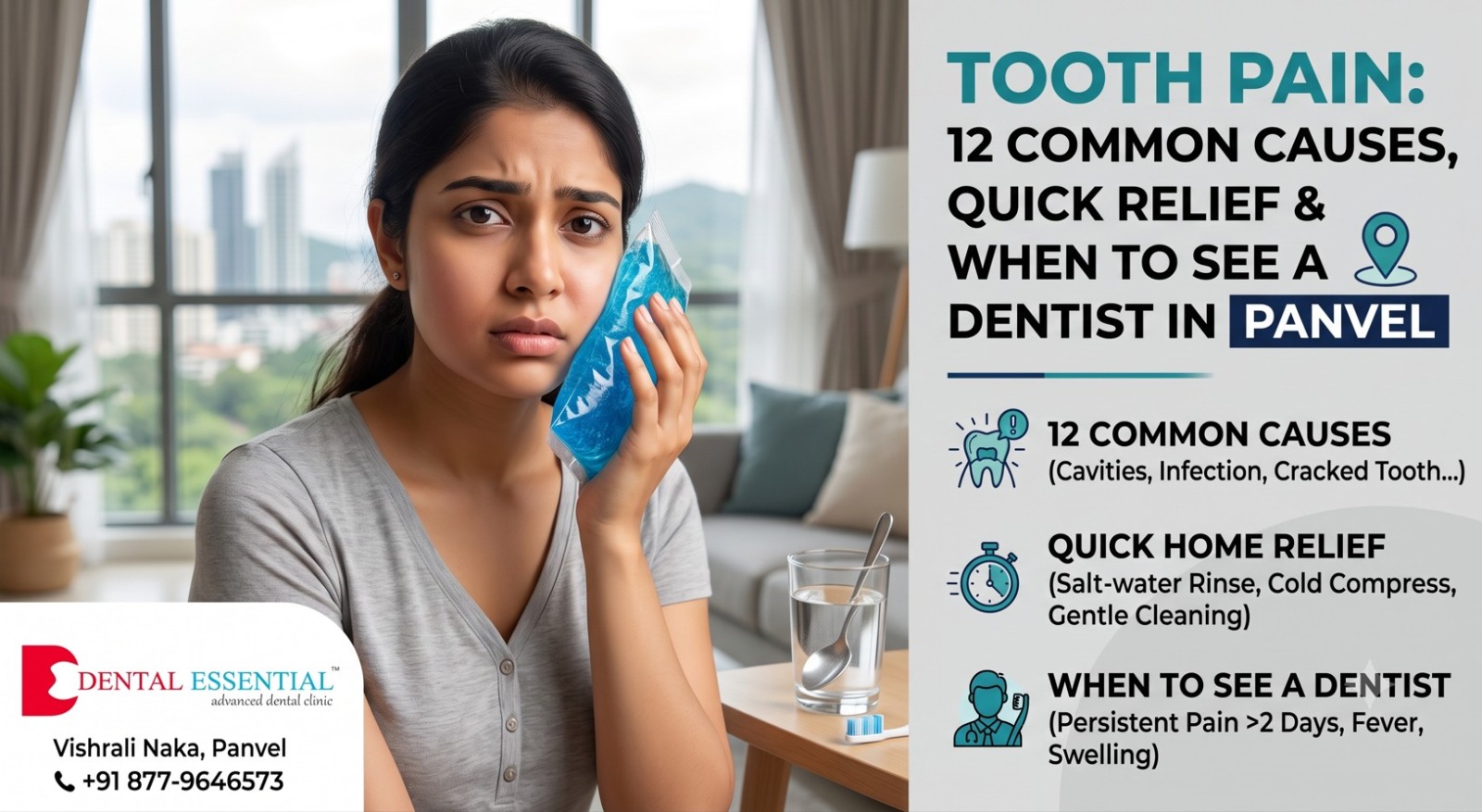
✦3. Use a Cold Compress Outside the Cheek
If there is local swelling or throbbing, place a cold pack wrapped in cloth on the outside of your cheek.
Do not place ice directly against the skin or tooth.
Cold can temporarily reduce discomfort and swelling.
✦4. Keep the Area Clean
Brush gently.
If you believe food has become trapped between two teeth, carefully cleaning the area may reduce pressure.
Do not use:
needles
pins
toothpicks aggressively
other sharp instruments
to dig into the gum or cavity.
✦5. Eat Soft Foods
Until the tooth is examined, choose foods that require less chewing.
Try to chew on the other side.
Avoid chewing hard foods directly on a painful or potentially cracked tooth.
✦6. Avoid Pain Triggers Before Bed
Temporarily avoid:
if they aggravate symptoms.
✦7. Consider Appropriate Over-the-Counter Pain Relief
Over-the-counter pain medication can temporarily reduce dental pain.
For adults who can safely take them, medicines such as ibuprofen or paracetamol are commonly used for acute dental discomfort.
However:
People with certain medical conditions, pregnancy, kidney problems, stomach ulcers, blood-thinning medication or other contraindications may need different advice.
Pain medication should not replace dental treatment.
What NOT to Do When You Have Severe Toothache at Night
Some home remedies found online can cause more trouble than they solve.
✦Do Not Put Aspirin Directly on Your Tooth or Gum
Swallowing medication as directed and placing a tablet directly against oral tissue are completely different things.
Aspirin held against gums can irritate or damage tissue.
✦Do Not Start Random Antibiotics
Do not take:
old antibiotics,
someone else’s prescription,
or antibiotics purchased solely because your tooth hurts.
Most dental pain needs diagnosis and definitive dental treatment.
✦Do Not Apply Heat to Significant Facial Swelling
A cold compress is generally the safer temporary measure for external swelling while arranging professional assessment.
✦Do Not Keep Treating the Symptom for Several Nights
If you need repeated pain medication every night just to sleep, the dental problem needs investigation.
Home remedies are a bridge to treatment—not a treatment plan.
How Can I Sleep With a Toothache?
If you are trying to make it through the night before your dental appointment:
The goal is simply to make yourself more comfortable until proper dental care is available.
Does Tooth Pain at Night Mean You Need a Root Canal?
No—not automatically.
This is an important misconception.
Nighttime toothache may be caused by:
Only some of these require root canal treatment.
A simple cavity may need only a filling.
A gum problem may require periodontal care.
A problematic wisdom tooth may require extraction.
A cracked tooth may need a crown.
A tooth affected by irreversible pulp inflammation or infection may require a root canal.
That is why a dentist should diagnose the cause before recommending treatment.
When May Root Canal Treatment Be Needed?
Root canal treatment may be considered when the dental pulp has become irreversibly inflamed or infected but the tooth can still be restored.
Possible warning signs include:
At Dental Essential, patients requiring root canal treatment in Panvel can be evaluated with a clinical examination and digital X-ray where appropriate.
Depending on the individual tooth and complexity, some cases may be suitable for single sitting root canal treatment in Panvel, while others require more than one appointment.
The goal is not simply to stop tonight’s pain.
The goal is to treat infection or damaged pulp and, where possible, save the natural tooth.
What If the Tooth Only Needs a Filling?
Not every painful cavity has reached the nerve.
If decay is still limited enough that the pulp remains healthy or recoverable, the damaged portion may be removed and restored with a filling.
This is one reason early diagnosis matters.
A cavity treated early may require relatively straightforward tooth coloured filling treatment in Panvel.
If the same cavity is ignored until bacteria reach the pulp, treatment can become more extensive.
When Is Nighttime Toothache a Dental Emergency?
A toothache that wakes you up is unpleasant, but not every case requires a hospital emergency department.
However, some symptoms require urgent action.
✦Seek Prompt Dental Care for:
✦Seek Emergency Medical Care Immediately If:
Breathing or swallowing problems associated with dental swelling can indicate that infection is spreading and should not wait for a routine dental appointment.
Toothache at 1 AM in Panvel: What Should You Do?
Imagine your tooth begins throbbing after Dental Essential’s normal clinic hours.
If there are no emergency warning signs, use safe temporary measures:
But if there is rapidly increasing facial or neck swelling, difficulty breathing or swallowing or another serious medical warning sign, do not wait for the dental clinic to reopen.
Seek immediate emergency medical attention.
Dental Essential’s current hours are:
Monday–Saturday10:00 AM–2:00 PM5:00 PM–9:00 PM
Sunday: Closed
How a Dentist Diagnoses Nighttime Tooth Pain
Good toothache treatment begins with diagnosis.
Your dentist may ask:
The examination may include:
✦Visual Dental Examination
Checking for cavities, swelling, damaged restorations, cracks and gum problems.
✦Dental X-Ray
X-rays can help identify deep decay, infection around roots, wisdom-tooth position and certain other problems that may not be visible during a normal examination.
✦Sensitivity Testing
Cold or other pulp tests may help determine how the nerve inside a tooth is responding.
✦Bite Testing
Useful when a cracked tooth or inflammation around the root is suspected.
✦Gum Examination
Helps determine whether discomfort originates from periodontal tissues.
This process helps avoid guessing whether a patient needs a filling, crown, root canal, gum treatment or extraction.
Treatments a Dentist May Recommend for Nighttime Toothache
✦Dental Filling
For a cavity that has not irreversibly affected the pulp.
✦Root Canal Treatment
For a restorable tooth with irreversible pulp inflammation or infection.
✦Dental Crown
For certain cracked, structurally weakened or extensively restored teeth.
✦Gum Treatment
When periodontal inflammation is responsible for symptoms.
✦Wisdom Tooth Removal
When an impacted or infected wisdom tooth repeatedly causes problems.
✦Replacement of a Damaged Filling or Crown
When an old restoration has fractured or leaked.
✦Night Guard
For selected patients whose symptoms are related to bruxism.
✦Tooth Extraction
When a tooth is too severely damaged to predictably restore.
The correct treatment depends on diagnosis, not on how severe the pain feels.
Why You Shouldn’t Keep Postponing a Dental Visit Because the Pain Goes Away in the Morning
This is probably the biggest behaviour trap with nighttime toothache.
At 2 AM:
“Tomorrow I’m definitely calling the dentist.”
At 9 AM:
“Actually, it feels better. Maybe I’ll wait.”
Then the same thing happens again several nights later.
This pattern can continue until the tooth develops:
Pain is not a perfect measure of disease severity.
A dental problem can progress even during pain-free periods.
If a tooth repeatedly wakes you at night, treat that pattern as useful information—not something to ignore once breakfast starts.
Nighttime Toothache and the Panvel Lifestyle
The biological causes of dental disease are the same whether somebody lives in Panvel, Mumbai, Pune or anywhere else.
Culture, religion, community or income do not determine whether someone develops a toothache.
What can matter are everyday habits.
For busy people commuting between Panvel, Navi Mumbai and Mumbai, it is easy to postpone a dental appointment because a weekday feels packed.
The problem is that dental decay and infection do not work according to a convenient schedule.
Similarly, frequent evening snacking or repeatedly sipping sweetened beverages can increase how often teeth are exposed to sugars and starches that decay-causing bacteria use to produce acids.
A practical approach is not to avoid every sweet food.
Instead:
Good dental prevention should fit real life rather than depend on unrealistic restrictions.
How to Prevent Future Nighttime Tooth Pain
✦Brush Twice Daily With Fluoride Toothpaste
Fluoride helps strengthen tooth enamel and prevent tooth decay.
✦Clean Between Your Teeth
Brushing alone cannot effectively clean every contact area.
Use floss or another interdental cleaning method appropriate for you.
✦Reduce Frequent Sugar Exposure
Frequency matters.
Repeated snacking and sipping sugary beverages throughout the day gives oral bacteria repeated opportunities to produce acids.
✦Do Not Ignore Sensitivity
Sensitivity is not always serious, but recurring or worsening sensitivity deserves evaluation.
✦Replace Damaged Dental Restorations
If a filling or crown feels loose, cracked or different when you bite, have it checked.
✦Ask About Grinding
Morning headaches, jaw soreness and worn teeth can be clues that you clench or grind while sleeping.
✦Have Regular Dental Check-Ups
Routine dental check-ups may identify cavities, restoration problems and gum disease before they produce severe night pain.
Looking for Emergency Dental Care or a Dentist in Panvel?
A search for:
dentist near me
dental clinic near me
nearby dentist
local dentist
dentist open now
dental clinic open now
or
emergency dental care in Panvel
usually comes from someone who wants relief quickly.
Location certainly matters when you are in pain.
But it should not be the only consideration.
When choosing a dental clinic in Panvel, look for:
rather than simply choosing whichever advertisement appears first.
Why Consider Dental Essential for Toothache Treatment in Panvel?
Dental Essential – Advanced Dental Clinic provides general, restorative, cosmetic, orthodontic, pediatric and implant-related dental care at Vishrali Naka, Panvel.
The clinic evaluates dental problems including:
Dental Essential’s current treatment range includes:
The clinic is led by Dr. Sameer Ramchandra Gharat, Prosthodontist & Implantologist, who holds BDS and MDS qualifications in Prosthodontics & Implantology and he has 16+ years of experience.
Patients looking for an advanced dental clinic in Panvel, family dentist, general dentist or painless dental treatment in Panvel can schedule an examination so that treatment is based on the actual diagnosis rather than temporary symptom relief.
**Dental Essential – Advanced Dental Clinic, Panvel**
📍 Shop 16, Bldg 7/B, Gurusharnam Complex, Vishrali Naka, Panvel – 410206
📞 +91 877-9646573
Opening Hours:Monday–Saturday: 10:00 AM–2:00 PMMonday–Saturday: 5:00 PM–9:00 PMSunday: Closed
The clinic serves patients from Panvel, Old Panvel, New Panvel, Khandeshwar, Kamothe, Kalamboli, Karanjade, Kharghar, Taloja, Ulwe and nearby Navi Mumbai areas.
Frequently Asked Questions About Toothache at Night
✦Why is tooth pain worse at night?
Tooth pain may feel more severe at night because lying flat can make throbbing around inflamed tissues more noticeable and there are fewer distractions competing with pain signals. Teeth grinding during sleep may also worsen discomfort.
✦Why does my tooth hurt only when I lie down?
A painful or inflamed tooth may feel more noticeable in a horizontal position. If this happens repeatedly, a dentist should investigate causes such as decay, pulp inflammation, infection or a cracked tooth.
✦Why does my toothache keep me awake?
Deep decay, pulp inflammation, dental infection and other painful dental conditions can create spontaneous or throbbing pain that disrupts sleep. Severe recurring night pain should be examined.
✦How can I stop tooth pain at night?
Temporary measures include keeping your head slightly elevated, rinsing with warm salt water, applying a cold compress externally, avoiding trigger foods and using an appropriate over-the-counter pain reliever if it is safe for you.
These measures do not cure the underlying dental problem.
✦What is the best sleeping position for toothache?
Keeping your head slightly elevated rather than lying completely flat may reduce throbbing for some people. Choose the position that causes the least pressure or discomfort.
✦Does throbbing tooth pain mean infection?
It can.
A dental infection or abscess may cause severe constant throbbing, but throbbing alone is not enough for diagnosis.
Swelling, fever, bad taste, pain while biting or facial swelling make urgent assessment more important.
✦Does toothache at night mean I need root canal treatment?
Not necessarily.
Night pain can result from cavities, cracks, gum disease, wisdom teeth, sensitivity or grinding.
Root canal treatment is generally considered when the pulp is irreversibly inflamed or infected and the tooth can be saved.
✦Why does my toothache disappear in the morning?
Pain may seem less noticeable after sitting upright, becoming busy or taking medication.
In some cases, symptoms naturally fluctuate.
However, temporary improvement does not prove that the underlying problem has healed.
✦Can a cavity cause severe tooth pain at night?
Yes.
As decay becomes deeper and approaches or reaches the dental pulp, pain can become spontaneous, lingering or severe enough to interrupt sleep.
✦Can teeth grinding cause nighttime tooth pain?
Yes.
Sleep bruxism can strain the teeth and jaw and may cause morning headaches, jaw soreness, sensitivity or dental damage.
✦Can wisdom teeth cause pain at night?
Yes.
Impacted or partially erupted wisdom teeth can become painful or infected. Symptoms may include pain behind the last molar, gum swelling, jaw discomfort or difficulty opening the mouth.
✦Is salt water good for toothache?
A warm salt-water rinse can help clean the mouth and soothe irritated tissues temporarily.
It does not repair decay or cure a dental infection.
✦Should I use clove oil for severe toothache?
Clove-derived products are frequently discussed online for temporary numbing, but concentrated oils can irritate oral tissues and do not treat the cause of tooth pain.
Safer first-line temporary measures include appropriate pain relief, salt-water rinsing and professional dental evaluation.
✦How long can I wait with toothache?
If pain lasts more than about two days, repeatedly returns or is severe, arrange a dental examination sooner.
Do not wait if there is facial swelling, fever, bad taste or discharge, significant pain while biting or rapidly worsening symptoms.
✦Is severe toothache at night an emergency?
Severe toothache deserves urgent dental assessment, particularly with swelling or fever.
If mouth or neck swelling causes difficulty breathing, swallowing or speaking, seek emergency medical care immediately.
✦Where can I get toothache treatment in Panvel?
Dental Essential provides tooth-pain assessment at Vishrali Naka, Panvel. Depending on the diagnosis, treatment may include a filling, root canal treatment, crown, gum treatment, wisdom tooth care or another appropriate procedure.
Final Takeaway
A toothache that becomes unbearable as soon as you lie down can make the entire night feel endless.
But nighttime itself is rarely the real problem.
The pain may be exposing:
deep tooth decay, pulp inflammation, a dental abscess, cracked tooth, damaged filling, gum disease, impacted wisdom tooth, bruxism, sensitivity or referred sinus pain.
Temporary remedies may help you get through the night.
They should not become a substitute for diagnosis.
If your toothache:
book a dental examination.
For toothache treatment, painless root canal treatment, dental fillings, wisdom tooth assessment or emergency dental care in Panvel,
Contact: Dental Essential – Advanced Dental Clinic📍 Shop 16, Bldg 7/B, Gurusharnam Complex, Vishrali Naka, Panvel – 410206
📞 +91 877-9646573
Ready for a Healthier, Straighter Smile?
Consult with expert dentists at Dental Essential Clinic in Panvel. Get personalized treatment plans & affordable care.
Share this article